
Posted Date : 24 Aug 2026
Outline
Introduction: Understanding App Development Costs in India
Average Cost to Build an App in India
App Development Cost by Type
Basic Apps
Medium-Complexity Apps
Advanced Apps
Cost of Building an Android App
Cost of Building an iOS App
Cost of Building a Cross-Platform App
Factors That Affect App Development Cost
App Features and Functionality
UI/UX Design
Development Technology
Backend Development
Third-Party Integrations
Security Requirements
Testing and Quality Assurance
App Maintenance
App Development Cost Based on Features
Cost of Developing an E-Commerce App
Cost of Developing a Food Delivery App
Cost of Developing a Taxi Booking App
Cost of Developing a Social Media App
Cost of Developing an Education App
Cost of Developing a Healthcare App
Cost of Developing a Business App
Cost of Developing an AI-Powered App
Freelancer vs App Development Company in India
In-House App Development Cost
Cost of App Design and UI/UX
Backend and API Development Costs
Testing and Quality Assurance Costs
App Publishing Costs
App Maintenance and Updates
Hidden Costs to Consider
How Long Does It Take to Build an App?
How to Reduce App Development Costs
How to Choose the Right App Development Partner
What Should an App Development Budget Include?
Is It Cheaper to Build an MVP First?
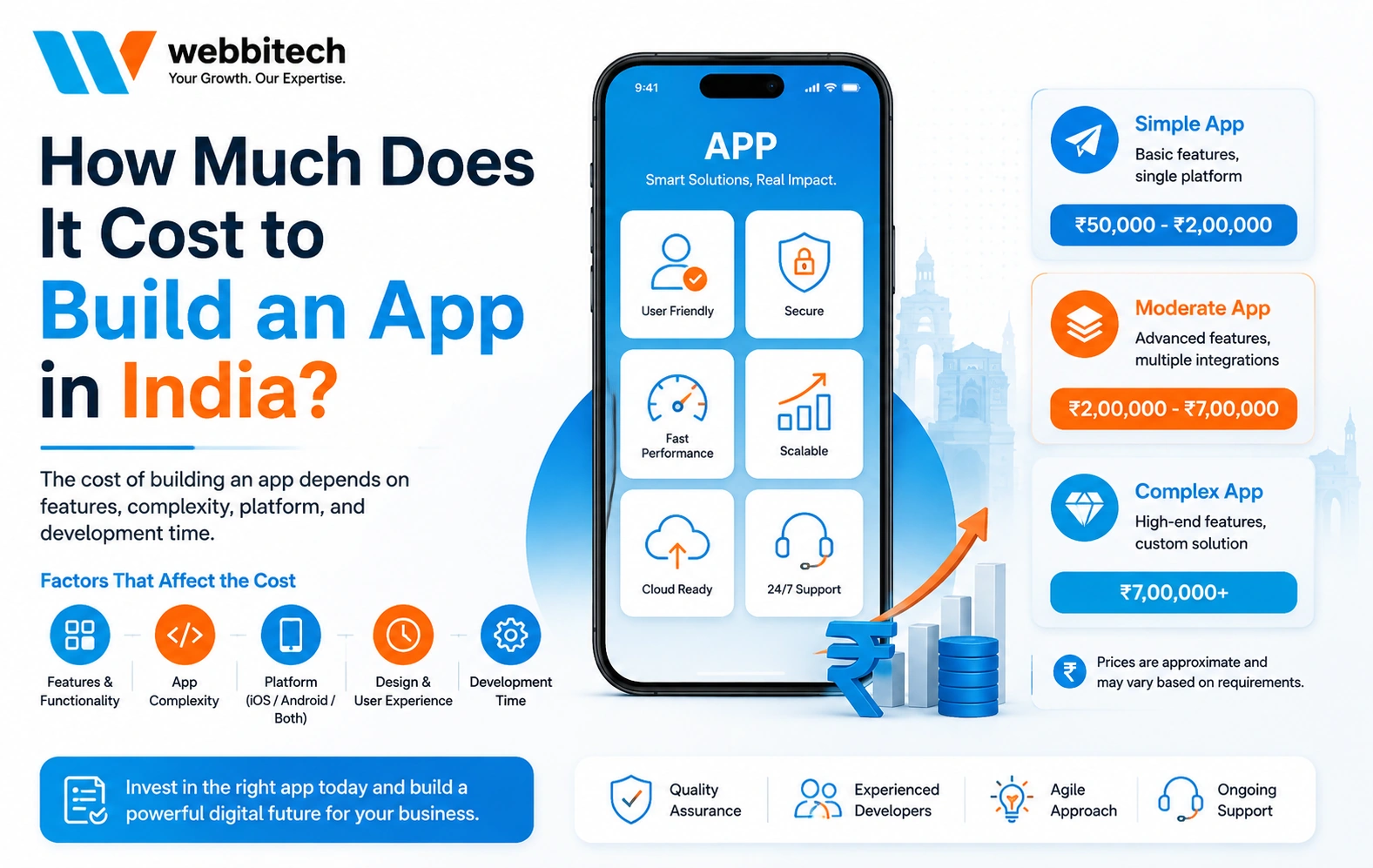
Building a mobile application in India can cost anywhere from ₹1 lakh to ₹50 lakh or more, depending on the application's complexity, features, technology stack, design requirements, integrations, security, development team, and post-launch support.
A simple application with a few screens and basic functionality may require a relatively modest investment. A sophisticated platform involving real-time tracking, online payments, artificial intelligence, video streaming, complex dashboards, or multiple user roles can become considerably more expensive.
There is no universal price tag for app development. The architecture behind the application matters just as much as the visible interface.
A broad estimate for mobile app development in India can be divided into three categories:
| App Type | Approximate Cost | Typical Development Time |
|---|---|---|
| Basic App | ₹1 lakh – ₹5 lakh | 1–3 months |
| Medium-Complexity App | ₹5 lakh – ₹15 lakh | 3–6 months |
| Advanced App | ₹15 lakh – ₹50 lakh+ | 6–12+ months |
These figures are indicative rather than fixed quotations. An application with fewer screens but complicated backend processing can cost more than a visually elaborate application with straightforward functionality.
For example, a simple company profile application might have attractive animations and several pages but require little backend engineering. Conversely, a logistics application may look relatively simple while relying on GPS, routing, real-time synchronization, notifications, payment processing, APIs, and administrative systems.
The type of application is one of the first determinants of development expenditure.
Basic applications generally contain limited functionality. They may include static or semi-dynamic content, contact forms, authentication, simple notifications, or a small database.
Examples include:
Business information apps
Portfolio applications
Event applications
Simple calculators
Basic booking applications
Content-based applications
A basic app can typically fall within the ₹1 lakh to ₹5 lakh range, depending on design and technical requirements.
Medium-level applications usually require user accounts, databases, APIs, payment gateways, notifications, dashboards, search, filters, or role-based access.
Examples include:
E-commerce applications
Education platforms
Appointment-booking applications
Service marketplace applications
Restaurant ordering applications
Customer management applications
Development costs commonly range from ₹5 lakh to ₹15 lakh.
Advanced applications demand substantial engineering effort. They may include real-time communication, artificial intelligence, machine learning, location tracking, video processing, sophisticated analytics, multiple integrations, or extensive administrative infrastructure.
Such applications can cost ₹15 lakh to ₹50 lakh or more.
Large-scale platforms may exceed this range when they require enterprise-grade infrastructure, substantial concurrency, complex data architecture, or highly specialized engineering.
Android development can be comparatively economical when the application is designed for a defined set of devices and uses established frameworks.
A basic Android application may cost around ₹1 lakh to ₹5 lakh, while medium and advanced applications can move into the ₹5 lakh–₹50 lakh+ range.
The final cost depends more on functionality than on the operating system itself.
iOS applications require development for Apple's ecosystem and must adhere to Apple's technical and interface guidelines.
A straightforward iOS application may cost approximately ₹1.5 lakh to ₹6 lakh, while more complex products can cost considerably more.
If an application needs both iOS and Android versions, the budget must account for the additional engineering, testing, device compatibility, and release management involved.
Cross-platform frameworks allow developers to create applications that operate across multiple platforms using a shared codebase.
Common technologies include:
Flutter
React Native
.NET MAUI
Other modern cross-platform frameworks
Cross-platform development can reduce duplicated engineering effort. However, it is not automatically cheaper for every project.
Applications involving highly specialized native functionality may still require platform-specific development.
Several variables influence the final quotation.
Features are usually the largest cost determinant.
A login system is relatively straightforward. A sophisticated authentication system involving multiple roles, biometric authentication, device verification, and security controls requires substantially more work.
Features such as payments, real-time chat, GPS tracking, video calls, AI, subscriptions, and recommendation engines can significantly increase development complexity.
Design is more than choosing colors and placing buttons.
A professional application requires the following:
User research
Information architecture
Wireframes
User journeys
Interface design
Prototypes
Responsive layouts
Accessibility considerations
Design-system development
A highly customized interface can increase the overall project cost but may substantially improve usability and product differentiation.
The technology stack influences development speed, scalability, maintenance, and specialist availability.
A project may use native Android and iOS technologies or a cross-platform framework.
The right choice depends on the product rather than simply selecting the technology with the lowest initial quotation.
The backend is the application's unseen machinery.
It can manage:
User accounts
Databases
Authentication
Transactions
APIs
Notifications
Business logic
Analytics
File storage
Administrative operations
Applications with sophisticated backend architecture generally require more engineering resources.
External services can add both development and recurring costs.
Examples include:
Payment gateways
Google Maps
SMS services
Email platforms
Cloud storage
Social login
CRM systems
Accounting software
Analytics platforms
AI APIs
Integration is rarely just a matter of inserting a plugin. Developers must handle authentication, API limitations, error states, security, data synchronization, and future compatibility.
Applications handling financial, personal, healthcare, or confidential business information require stronger security controls.
Potential requirements include encryption, secure authentication, access control, audit logging, secure API architecture, vulnerability testing, and data-protection measures.
Security should be considered an architectural requirement rather than an afterthought.
Testing determines whether an application behaves consistently across devices, operating-system versions, network conditions, and user scenarios.
Quality assurance may involve the following:
Functional testing
Usability testing
Performance testing
Security testing
Compatibility testing
API testing
Regression testing
Device testing
More sophisticated applications naturally require more extensive testing.
Launching an application is not the end of development.
Operating-system updates, security patches, bug fixes, server changes, new devices, third-party API modifications, and new business requirements can all require future engineering work.
A rough feature-level perspective can help businesses understand where their budget goes.
| Feature | Relative Complexity |
|---|---|
| Login and Registration | Low |
| User Profile | Low |
| Push Notifications | Low–Medium |
| Search and Filters | Medium |
| Payment Gateway | Medium |
| Admin Dashboard | Medium |
| Chat | Medium–High |
| GPS Tracking | High |
| Video Calling | High |
| AI Features | High |
| Real-Time Data | High |
| Advanced Analytics | High |
| Multi-Vendor Marketplace | Very High |
The cumulative effect is important. Ten inexpensive features can still produce an expensive application when they interact with one another.
An e-commerce application typically needs product catalogs, categories, search, filters, user accounts, carts, wish lists, checkout, payments, order management, notifications, and administration.
A basic e-commerce application may cost approximately ₹3 lakh to ₹7 lakh.
A more sophisticated platform with vendor management, advanced inventory, personalized recommendations, coupons, logistics integration, analytics, and multiple payment options may cost ₹7 lakh to ₹20 lakh or more.
Food delivery applications usually involve several interconnected systems.
A complete platform may require:
Customer application
Restaurant/vendor interface
Delivery-partner application
Admin dashboard
Restaurant management
Order tracking
GPS integration
Online payments
Push notifications
Ratings and reviews
Depending on the scope, development can range from approximately ₹5 lakh to ₹20 lakh+.
The number of user roles and real-time functionality makes this category more intricate than a standard ordering application.
Taxi and ride-booking applications require real-time location services, driver availability, trip management, fare calculation, booking workflows, notifications, and often payment integration.
A basic taxi application may begin around ₹5 lakh, while a comprehensive platform can reach ₹15 lakh to ₹30 lakh or more.
Advanced routing, surge pricing, driver analytics, wallet systems, multi-city operations, and sophisticated dispatch algorithms can push the cost considerably higher.
Social applications can be deceptively expensive.
A basic social platform might include:
Registration
Profiles
Posts
Likes
Comments
Follow systems
Notifications
More advanced products can require messaging, video uploads, live streaming, content moderation, recommendation algorithms, stories, communities, creator tools, and sophisticated media infrastructure.
Development costs can therefore range from ₹5 lakh to ₹30 lakh+, depending on the ambition of the platform.
Education applications vary substantially in scope.
A basic learning application may contain course content, videos, quizzes, user accounts, and progress tracking.
More advanced systems can incorporate:
Live classes
Online examinations
Certificates
Subscription management
Teacher dashboards
Student dashboards
Assignment systems
Discussion forums
AI-based learning assistance
A typical education application may cost approximately ₹3 lakh to ₹15 lakh+.
Healthcare applications can involve sensitive information and therefore require careful engineering.
Potential functionality includes appointment booking, doctor profiles, patient records, teleconsultation, prescriptions, payments, reminders, and notifications.
A basic healthcare application may cost around ₹4 lakh to ₹10 lakh, while advanced healthcare platforms can exceed ₹15 lakh.
Compliance, privacy, security, integrations, and medical workflows can have a significant impact on the budget.
Business applications are often built around a specific operational requirement.
Examples include:
CRM applications
Employee management systems
Inventory applications
Field-service applications
Sales applications
Internal communication platforms
Workflow automation systems
Costs can range from ₹2 lakh to ₹20 lakh+, depending on the number of workflows, users, integrations, and administrative functions.
Artificial intelligence can introduce another layer of complexity.
An AI-enabled application might use the following:
AI chatbots
Recommendation engines
Document analysis
Image recognition
Voice processing
Predictive analytics
Generative AI
Personalization
The cost depends on whether the application uses an external AI API or requires a custom-trained model.
A relatively simple AI integration may add ₹1 lakh to ₹5 lakh+ to a project, whereas custom AI engineering can require substantially larger budgets.
API usage can also introduce recurring operational expenses after launch.
The development partner can influence both cost and project management.
Freelancers may offer lower initial development costs and can work well for small, clearly defined applications.
However, a complex application can become difficult to manage when it requires separate expertise in design, backend engineering, mobile development, DevOps, testing, and security.
An app development company typically provides a multidisciplinary team.
This may include:
Project managers
UI/UX designers
Mobile developers
Backend developers
QA engineers
DevOps specialists
Business analysts
The initial quotation may be higher, but structured project governance can reduce certain execution risks.
Hiring an internal development team involves more than salaries.
A company may need to budget for:
Recruitment
Salaries
Employee benefits
Software licenses
Development tools
Hardware
Cloud infrastructure
Management
Training
Testing devices
For companies intending to continuously build and maintain multiple digital products, an internal team can make strategic sense.
For a single application, outsourcing may sometimes be more economical.
UI/UX design can range from approximately ₹50,000 to ₹5 lakh+, depending on the number of screens and sophistication.
A professional design process generally includes wireframes, user flows, visual design, prototypes, and developer-ready design specifications.
Skipping design research to save money can be counterproductive. Poor navigation often creates higher costs later when users abandon the product or major interface revisions become necessary.
Backend engineering can represent a substantial portion of an application's budget.
Developers may need to create:
REST or GraphQL APIs
Databases
Authentication systems
Admin panels
Cloud infrastructure
Data processing
Payment workflows
Notification systems
Third-party integrations
A simple backend may cost relatively little, while a scalable architecture supporting thousands or millions of users requires significantly more planning and engineering.
Quality assurance can account for approximately 10%–20% or more of a software project's development effort, depending on complexity.
Testing is particularly important for applications involving transactions, healthcare data, financial services, or real-time interactions.
A launch without adequate testing can result in crashes, failed payments, incorrect data, security vulnerabilities, and reputational damage.
Publishing an application involves developer accounts, store compliance, release preparation, screenshots, descriptions, privacy documentation, testing, and review processes.
The store account fees themselves are usually much smaller than the engineering costs.
The more significant expenditure comes from preparing the application for production and maintaining compliance with platform requirements.
A practical rule is to reserve approximately 15%–25% of the original development cost annually for maintenance, although actual expenditure varies substantially.
Maintenance can include:
Bug fixes
Security updates
Operating-system compatibility
Server maintenance
Performance optimization
Third-party API changes
Feature enhancements
Monitoring
Database management
An application that receives no maintenance can gradually become brittle as its surrounding technology ecosystem evolves.
The initial development quotation is not always the complete cost of ownership.
Businesses should consider the following:
Cloud hosting
Domain and infrastructure
SMS charges
Email services
Payment gateway charges
Maps API usage
AI API consumption
Push notification infrastructure
Analytics tools
Security testing
App maintenance
Customer support
Marketing
Content creation
App-store compliance
Future feature development
These operational expenses can become substantial after the application starts acquiring users.
Development timelines vary according to scope.
A basic application may take 1–3 months.
A medium-complexity application may require 3–6 months.
A sophisticated application can require 6–12 months or longer.
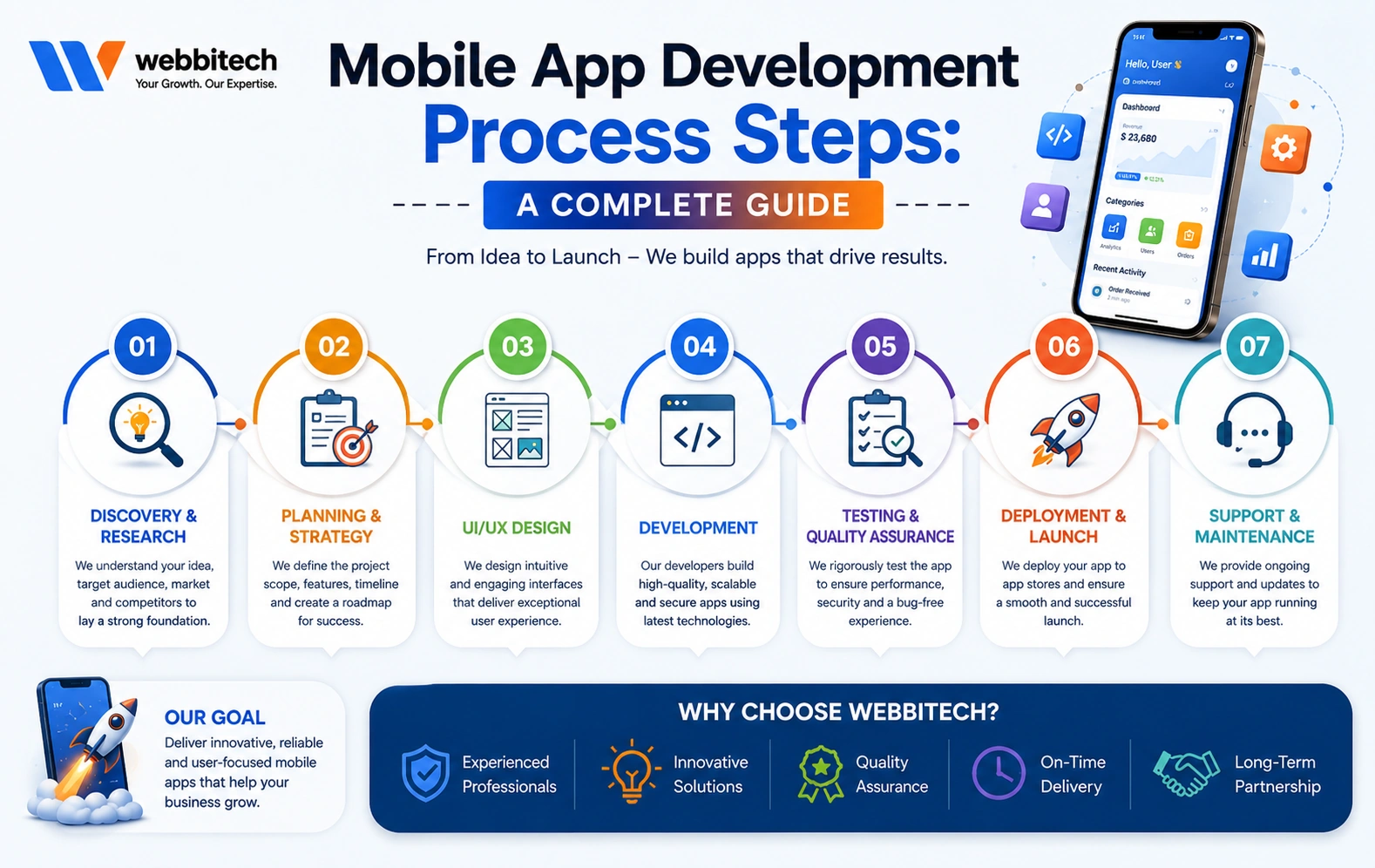
The timeline includes more than coding. Planning, UX design, development, integration, testing, revisions, deployment, and stabilization all consume time.
Rushing the process can create technical debt that becomes expensive to unwind later.
Reducing cost does not necessarily mean choosing the cheapest developer.
A better approach is to control scope intelligently.
An MVP, or Minimum Viable Product, focuses on the essential functionality required to validate the business concept.
Instead of building 30 features immediately, launch with the 8–10 features that genuinely matter.
Classify features into:
Essential
Important
Useful
Future enhancement
Build the first release around the essential layer.
A suitable cross-platform framework can reduce duplicated development effort when the application's requirements support it.
Avoid unnecessary experimentation in the first release.
Established technologies can reduce development risk, recruitment friction, and maintenance complexity.
Unclear requirements create scope creep.
A detailed project specification helps establish what is included, what is excluded, and how each feature should behave.
Cost should not be the only criterion.
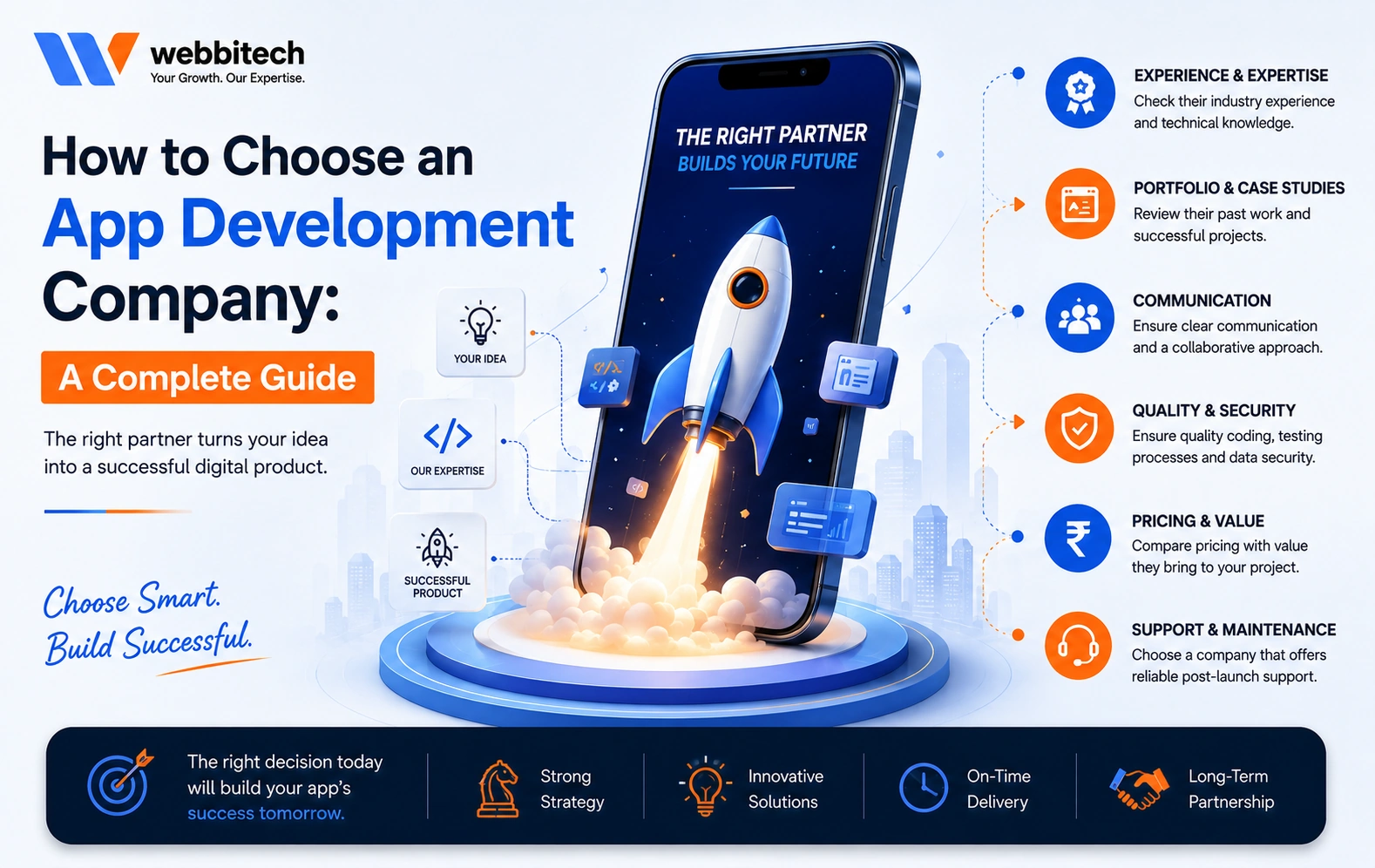
Before selecting an app development company, evaluate:
Previous projects
Technical expertise
Industry experience
Development methodology
UI/UX capability
Testing process
Security practices
Communication
Post-launch support
Client reviews
Portfolio quality
Contract clarity
Ask for a detailed proposal rather than accepting a single-line quotation.
A good proposal should explain the scope, milestones, technologies, estimated timeline, deliverables, payment schedule, testing process, and maintenance terms.
A comprehensive budget should ideally account for:
Business analysis
UI/UX design
Mobile development
Backend development
API development
Database architecture
Third-party integrations
Testing
Security
Deployment
Project management
Infrastructure
Maintenance
Future enhancements
This provides a more realistic picture of the total investment.
For many startups and businesses, yes.
An MVP reduces the amount of capital committed before market validation.
Suppose a complete application is estimated at ₹20 lakh. Instead of spending the entire amount immediately, a business could develop a focused first version costing perhaps ₹5 lakh–₹8 lakh, depending on requirements.
The MVP can then generate user feedback and operational data.
Those insights can guide the second phase.
This is particularly valuable when the business model has not yet been validated.
So, how much does it cost to build an app in India?
A basic mobile application may cost around ₹1 lakh–₹5 lakh, a medium-complexity application may fall around ₹5 lakh–₹15 lakh, and a sophisticated application can range from ₹15 lakh to ₹50 lakh or considerably more.
The actual figure depends on functionality, UI/UX complexity, platform choice, backend architecture, integrations, security, testing, development expertise, and long-term maintenance.
The most reliable way to establish a budget is to begin with a detailed feature list and technical requirement document. Once the scope is crystallized, an app development company can estimate the development effort, timeline, infrastructure requirements, and ongoing costs with far greater precision.
For businesses entering mobile technology for the first time, an MVP-led strategy is often prudent: build the essential product, validate demand, learn from real users, and then scale the application systematically.

Have a project in mind? Let’s build something amazing together.
Webbitech — A Leading Web Design & Web Development Company with 15+ Years of SEO & Digital Marketing Expertise, Delivering Countless Success Stories
From idea to execution, we help businesses create high-performing websites and applications.
Start your journey today and take your brand to the next level.


 Get Free Consulting
Get In Touch
Get Free Consulting
Get In Touch
