Posted Date : 04 Jun 2026
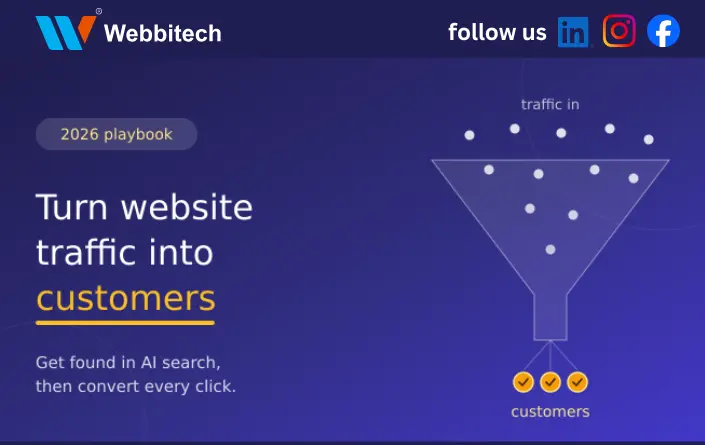
Most websites attract visitors and convert almost none of them. The median landing page converts at just 6.6% (Unbounce, via Foundry CRO), so a busy site can still produce zero customers. In 2026, winning means two jobs: earning visibility in AI-driven search, then turning those clicks into revenue.
This guide covers both. You will see the Google ranking factors that matter now, the conversion tactics that move the needle, and a simple way to measure whether your website is actually working.
Key Takeaways
- The median landing page converts at 6.6%; the top 10% hit 11.45%+ (Unbounce).
- AI Overviews now appear on roughly 48% of queries, so being cited beats ranking alone (BrightEdge).
- E-E-A-T and original, first-hand content drive 2026 rankings after the March and May core updates.
- A single, focused call to action converts about 29% better than multiple CTAs.
- Short forms, fast pages, and clear message-match are the fastest conversion wins.
A traffic problem and a conversion problem look identical in a revenue report, but they are different. If the median page converts at 6.6% (Foundry CRO, 2026), then 9,340 of every 10,000 visitors leave without acting. Traffic that does not convert is a cost, not an asset.
The gap usually comes from a few repeat offenders. The page promises one thing and the ad or search snippet promised another. The call to action is buried or competes with five others. The form asks for too much, too soon. Or the page loads slowly on mobile, where most visitors arrive.
<!-- INFORMATION GAIN: reframing "no leads" as a measurable diagnosis (traffic vs conversion vs intent) rather than a vague complaint -->
There is also a third, newer cause: the traffic itself has changed. As AI answers absorb more clicks, raw sessions fall while intent rises. The visitors who still click tend to want action, which makes conversion design more important than ever.
Internal link suggestion: link "conversion design" to your CRO services or methodology page.
Search in 2026 is answer-first, not link-first. AI overviews now appear on about 48% of tracked queries, up from roughly 30% a year earlier (BrightEdge data, via Ment Tech). Google AI Mode passed one billion monthly users after Google I/O 2026 (Launch Codex). Many searches now end without a click.
This is the zero-click reality. Users get the answer inside the search interface, so a top-ten ranking no longer guarantees traffic. The question shifts from "do I rank?" to "am I the source the AI cites?"
Two practical consequences follow. First, the content that gets pulled into AI answers is clear, well-structured, and demonstrably expert. Second, brand authority off your own site now feeds visibility, because earned media still drives the majority of AI citations (AuthorityTech, May 2026).
There is an upside hidden in this shift. Visitors who arrive after reading an AI answer often convert above average because they have already compared options and want confirmation (Incremys, 2026).
Ranking factors in 2026 reward proof of real expertise, not keyword coverage. After the March and May 2026 core updates, Google expanded E-E-A-T beyond health and finance to nearly all competitive queries, and thin "summary of the top results" content lost ground (ChannelPro, 2026). The factors below decide whether you earn both rankings and AI citations.
| Ranking factor (2026) | What Google rewards | What to do |
|---|---|---|
| Experience and originality | First-hand testing, original data, real screenshots | Publish results, case studies, and proprietary numbers |
| Expertise and accuracy | Correct, deep, credentialed content | Name your authors and show their qualifications |
| Authority and earned media | Citations, press, expert mentions | Earn links and mentions on trusted sites |
| Trust | Transparency, contact info, security | Add clear policies, real contact details, HTTPS |
| Helpful structure | Clear answers AI can extract | Lead each section with a direct 40 to 60 word answer |
| Structured data | Machine-readable context | Add schema in the HTML source, not via JavaScript |
| Core Web Vitals | Fast, stable, responsive pages | Fix load speed, especially on mobile |
The biggest change is philosophical. A high ranking and an AI citation are now separate prizes, and a strong page can win one without the other (The DigitalFlix, 2026). Optimize for clarity and trust, and you compete for both.
Internal link suggestion: link "Core Web Vitals" to a technical SEO checklist post.
You turn visitors into leads by removing friction and sharpening focus. A single, clear call to action converts about 29% better than pages with multiple CTAs, roughly 13.5% versus 10.5% (The Growth Stack, 2026). The mechanics of conversion are well documented, and most sites ignore them.
Start with message match. The headline must echo the promise that brought the visitor in, whether from an ad, a search result, or an AI answer. A mismatch is the most common reason a page underperforms its benchmark.
Then cut the form. Reducing fields to five or fewer can double conversions, and each extra field beyond five costs 20 to 30% (GenesysGrowth, via The Growth Stack). For top-of-funnel offers, ask only for a name and email, then qualify later.
Use the benchmarks below to judge your own pages honestly. A "good" rate beats your industry median by a clear margin, not a global average.
| Conversion benchmark (2026) | Rate | Source |
|---|---|---|
| Median, all industries | 6.6% | Unbounce |
| Top 25% of pages | 10%+ | Unbounce |
| Top 10% of pages | 11.45%+ | Unbounce |
| SaaS and technology | ~3.8% | Unbounce |
| Financial services | ~8.4% | Unbounce |
| Events and registration | ~12.3% | Unbounce |
Two more proven levers: personalized CTAs convert up to 202% better than generic ones, and companies with 40 or more landing pages generate about 12 times more leads (Colorlib, 2026). More targeted pages mean more precise message match.
Pages convert when they match what the visitor came to do, not just what they typed. Lead-generation pages tend to convert higher than ecommerce pages because a form fill asks for less commitment than a purchase (Incremys, 2026). The job is to map each page to a specific stage of intent.
Top-of-funnel visitors want to learn. Give them a useful guide and a low-friction offer, such as a checklist or a short newsletter. Middle-of-funnel visitors compare options. Give them proof: case studies, comparisons, and clear pricing context.
Bottom-of-funnel visitors are ready to act. Give them a direct path to a demo, quote, or call, with social proof close to the button. Sending a high-intent visitor to a generic homepage wastes the click.
This intent-first approach also helps with AI visibility. Self-contained, clearly answered pages are exactly what AI engines extract and cite, which feeds more high-intent traffic back to you.
A lead is the start of the sale, not the end, so capture and follow-up decide your real return. Most visitors are not ready to buy on the first visit, which is why long-form pages can generate far more leads for complex offers than short ones (Colorlib, 2026). Capture the relationship, then earn the sale over time.
Offer a reason to share contact details. A genuinely useful lead magnet, a template, a calculator, or a short course, converts browsers into known contacts you can reach again.
Then nurture with relevance. A short email sequence that answers objections and shows proof keeps your offer present until the buyer is ready. Speed matters too: contacting a new lead quickly, while intent is hot, sharply improves the odds of a conversation.
Internal link suggestion: link "email sequence" to your email marketing or lead-nurture guide.
Treat every customer as a future advocate. Reviews, testimonials, and earned mentions rebuild the authority signals that now power both rankings and AI citations.
You measure a website by revenue actions, not vanity traffic. Conversion rate, qualified leads, and cost per acquisition tell you whether traffic turns into customers; pageviews alone do not. In a zero-click world, you also need to track visibility you cannot click, such as AI citations and brand mentions.
Watch four things together. Track conversion rate by page and by traffic source, because email and AI-referred visitors often convert differently from paid search. Track assisted conversions, since many buyers touch several pages before acting.
Track your presence in AI answers, because a citation can drive demand even without a recorded click. And track Core Web Vitals, because slow pages quietly leak both rankings and conversions. After a core update, wait at least a week before drawing conclusions, as Google itself advises (Ment Tech, 2026).
If one number changes habits, make it the conversion rate by page. A one-point lift on a page with 10,000 monthly visitors is 100 extra conversions at the same traffic cost.
A website that just sits there is a fixable problem, not a permanent state. To turn website traffic into customers in 2026, win the new search game with original, trustworthy, well-structured content, then convert the clicks with focused pages, short forms, and a single clear call to action. Diagnose whether your issue is traffic, conversion, or intent, fix the weakest link first, and measure by revenue actions, not pageviews.
Want a faster start? Audit your three highest-traffic pages this week. Check message match, form length, and page speed, then run one A/B test on the primary call to action. Small, compounding changes are how sitting traffic becomes paying customers.
Internal link suggestion: link "Audit your three highest-traffic pages" to your website audit or contact page.
Why is my website getting traffic but no leads?
Usually the page has a conversion problem, not a traffic problem. The headline does not match the visitor's intent, the call to action is unclear, or the form is too long. With the median page converting at 6.6%, small friction fixes often produce large gains.
What are the most important Google ranking factors in 2026?
Trust, expertise, and original first-hand experience lead in 2026, now applied to nearly all competitive queries after the March and May core updates. Helpful structure, schema in the HTML source, earned media authority, and fast Core Web Vitals also strongly influence both rankings and AI citations.
How do AI overviews affect my website traffic?
AI overviews appear on roughly 48% of queries and answer many searches without a click. A top ranking no longer guarantees visits, so the goal shifts to being the source the AI cites. Visitors who do click after an AI answer often arrive with higher intent.
What is a good conversion rate for a website in 2026?
The median landing page converts at about 6.6%, with the top 25% above 10% and the top 10% above 11.45%. Rates vary by industry, from roughly 3.8% for SaaS to 12.3% for events, so compare against your own sector, not a global average.
What is the single fastest way to convert more traffic into customers?
Reduce friction on your highest-traffic page. Use one clear call to action, cut the form to five fields or fewer, and match the headline to the visitor's intent. A single focused CTA alone can lift conversions by roughly 29%.
Have a project in mind? Let’s build something amazing together.
Webbitech — A Leading Web Design & Web Development Company with 15+ Years of SEO & Digital Marketing Expertise, Delivering Countless Success Stories
From idea to execution, we help businesses create high-performing websites and applications.
Start your journey today and take your brand to the next level.