Posted Date : 18 Jul 2026
For most of the last decade, the advertisers who won weren't necessarily the ones with the best product or the cleverest copy. They were the ones who could buy the most precise third-party data — cookies, device IDs, purchased audience segments — and layer it on top of a decent campaign. That era is quietly ending, and almost nobody is talking about what's replacing it as loudly as they should be.
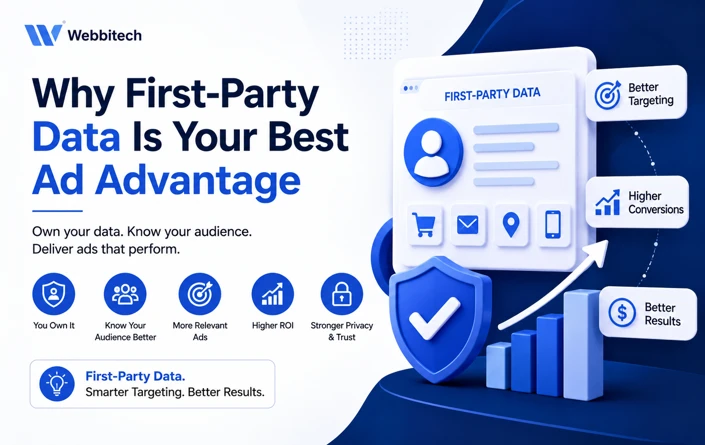
The new differentiator isn't a bigger budget. It's cleaner, better-owned first-party data — the information a business collects directly from its own customers, on its own terms, through its own channels.
Third-party data always had a structural weakness: it was borrowed, not owned. You didn't control how it was collected, how accurate it was, or how long you'd keep access to it. For years that was an acceptable tradeoff because the reach and precision were good enough to justify the fragility.
That tradeoff has flipped. Browser and platform restrictions have steadily eroded third-party tracking, and privacy regulation has moved from theoretical to enforced — regulators have already levied real fines against companies for mishandling consumer data, including cases tied to missing privacy policies and opt-out mechanisms. Meanwhile, consumers themselves have gotten more vocal: most say they want brands to be transparent about how their data gets used, and a majority say they're more likely to trust brands that actually explain it.
Put simply, the infrastructure that advertising used to lean on is degrading, and the public's patience for opaque data practices has largely run out. Borrowed certainty isn't a stable foundation to build a media strategy on anymore.
A lot of teams hear "first-party data" and think it just means an email list. That's part of it, but the real opportunity is broader and considerably more operational than a newsletter signup form.
Think of it in layers:
Most organizations already have pieces of this scattered across a CRM, an ecommerce platform, a support tool, and a handful of other systems that don't talk to each other. The actual differentiator isn't collecting more of this data — most companies already have plenty sitting in silos. It's connecting it into something usable.
It's tempting to file first-party data under "privacy box-checking" and move on. That undersells what's actually happening. Data collected directly from customers tends to be more accurate than data inferred through indirect tracking, because it comes straight from the source rather than through a chain of assumptions about behavior. It's also more complete, since you decide what to capture instead of settling for whatever a third party happened to gather. And because you collected it transparently, it's built to hold up under the regulatory environment rather than becoming a liability the moment enforcement tightens.
The performance case is genuinely strong, not just theoretical. Companies with mature first-party data strategies have reported meaningfully stronger customer retention and repeat-purchase rates, and some research points to notably higher revenue growth for organizations that lean into owned data over competitors still dependent on third-party sources. Analysts have also framed the broader industry shift bluntly: in an AI-driven marketing landscape, ownership and control of your own data has become a genuine strategic asset, not a nice-to-have.
There's also a subtler compounding effect worth naming directly: two companies can run near-identical campaigns — same platforms, same creative formats, even the same keywords — and get different results, because one of them recognizes returning visitors, remembers more context about them, and can follow up intelligently across weeks and months. That gap looks like luck from the outside. It's actually just better-connected data doing quiet, unglamorous work in the background.
If the opportunity is this clear, why isn't every company already capitalizing on it? Because building genuine first-party data infrastructure is harder than buying a data license used to be, and the difficulty shows up in a few consistent places.
Accuracy and completeness gaps. A meaningful share of marketers cite data accuracy as an ongoing problem in their first-party programs — stale records, duplicate profiles, and inconsistent formatting across systems are common, unglamorous obstacles.
Engaged-customer bias. First-party data naturally captures the customers who are already paying attention — people who log in, open emails, or fill out forms. Quieter customers, who may still be valuable, tend to leave a thinner data trail, creating blind spots if you're not careful about how you weight what you have.
Fragmentation across teams and tools. Data collected in a support tool, a checkout flow, and an email platform doesn't automatically become one coherent customer picture. Someone has to own the work of unifying it, and that's an organizational challenge as much as a technical one.
Skills the team may not have yet. Turning raw first-party data into something an ad platform or a personalization engine can actually use requires a mix of data literacy, some modeling capability, and decision-making processes most marketing teams haven't traditionally needed to build in-house.
None of these problems are exotic. They're just work — the kind of unglamorous infrastructure investment that's easy to deprioritize until the alternative (relying on third-party data that keeps getting less reliable) becomes obviously worse.
If you're convinced but unsure where to begin, the sequence that tends to work looks something like this:
The advertisers pulling ahead right now aren't necessarily spending more. They're building on a foundation — their own customer data, properly connected and properly consented — that doesn't erode every time a browser policy changes or a data broker's access gets cut off. That foundation compounds over time in a way borrowed data never could, because every interaction makes it a little more accurate, a little more complete, and a little harder for a competitor to replicate.
The uncomfortable part is that there's no shortcut to it. You can't buy your way into owning better customer relationships. But that's also exactly why it's a real, durable differentiator instead of just another tactic that gets copied by every competitor within a quarter.

Have a project in mind? Let’s build something amazing together.
Webbitech — A Leading Web Design & Web Development Company with 15+ Years of SEO & Digital Marketing Expertise, Delivering Countless Success Stories
From idea to execution, we help businesses create high-performing websites and applications.
Start your journey today and take your brand to the next level.