Posted Date : 18 Jul 2026
Most articles about Meta's Andromeda algorithm focus on what it means for marketers—creative strategy, targeting, and budgets. Fair enough, that's what most advertisers care about. But underneath all of that sits a genuinely fascinating engineering story: how do you build a system that can evaluate tens of millions of ads against a single person's preferences, in milliseconds, for billions of impressions a day, without the computing cost spiraling out of control?
That's the question this post answers. Not "What should I do differently?"—but "How does this thing actually work under the hood?"
Every ad recommendation system, at its core, has to answer one question: out of everything available, what should this specific person see? Meta's system does this in two stages. First, a retrieval stage narrows a massive pool of candidate ads down to a manageable shortlist. Then a ranking stage — essentially the auction — evaluates that shortlist in detail and picks a winner based on bid, predicted engagement, and ad quality.
For years, that retrieval stage worked, but it worked using relatively coarse, engineered rules — the digital equivalent of sorting mail into a handful of labeled bins before anyone actually reads it. That was fine when advertisers uploaded a modest number of creative variants per campaign.
Then everything changed. Automated creative tools, dynamic ad formats, and AI-assisted asset generation meant a single advertiser account could suddenly be juggling thousands of creative combinations instead of a handful. Multiply that across Meta's entire advertiser base, and the old retrieval stage became the bottleneck of the entire ads pipeline—the equivalent of trying to sort an ocean of mail using a system designed for a mailbox.
Meta's engineering team needed retrieval to get dramatically smarter without getting proportionally slower or more expensive. That constraint — smarter, not slower — is what Andromeda was built to satisfy.
The old approach to retrieval relied heavily on hand-engineered features: predefined signals that told the system, in a fairly rigid way, what to look for in matching an ad to a person. Andromeda replaces much of that with a large-scale deep neural network trained to construct its own representation of the relationship between a person and a piece of creative work—dynamically, at the moment of the request, rather than relying purely on features engineers decided in advance were important.
In practice, this means Andromeda can pick up on subtler, harder-to-articulate signals than a rules-based system ever could—patterns in how a creative is visually structured, contextual cues about what a person is likely receptive to at that specific moment, and interactions between the two that don't reduce neatly into a checklist. The tradeoff is that a model like this is far more computationally demanding than the simpler system it replaced. Which is where the hardware story comes in.
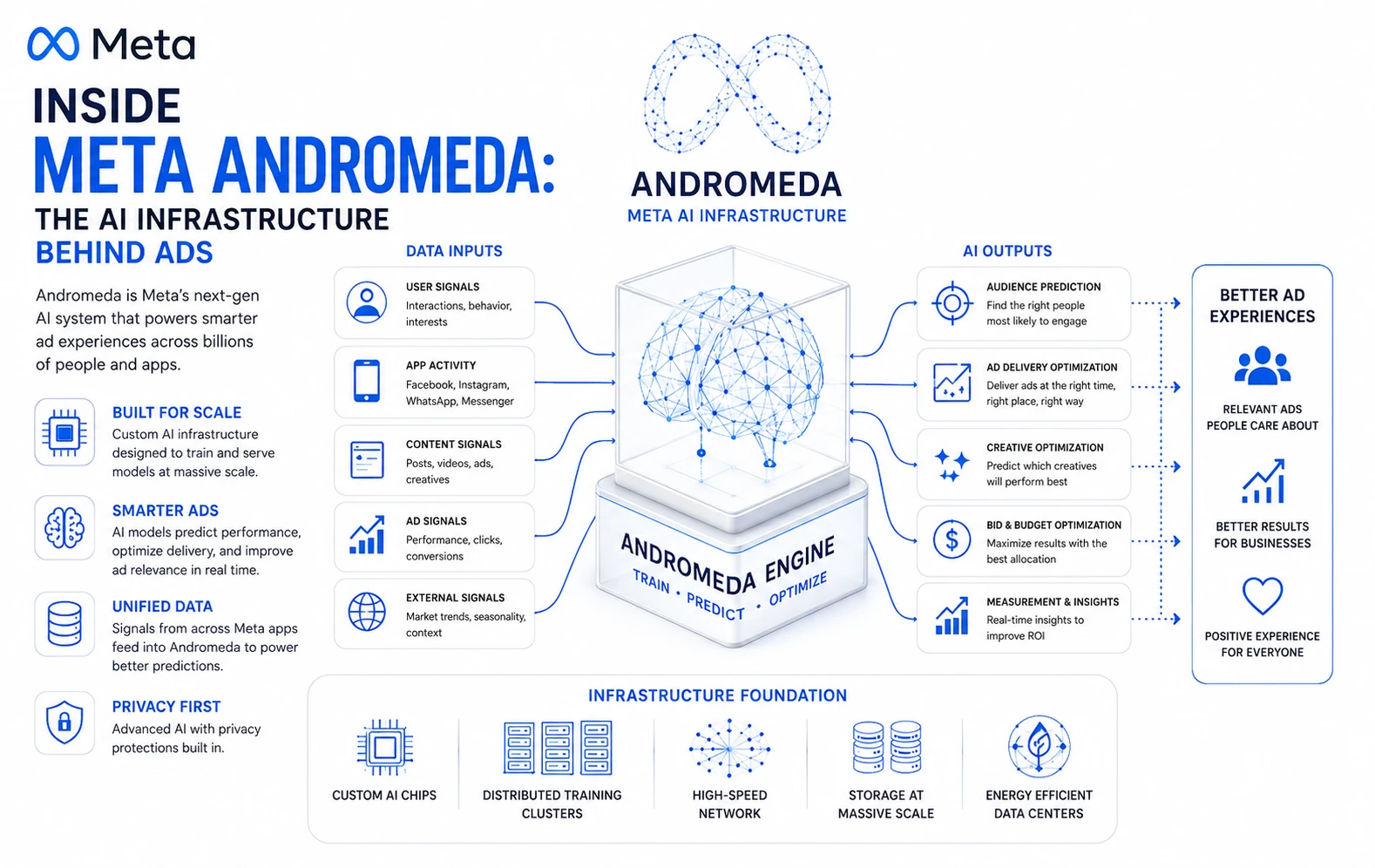
Running a model this complex, this many times per second, across Meta's entire user base, is not something you do on general-purpose servers. Meta built Andromeda around specialized accelerator hardware, combining two things: NVIDIA's Grace Hopper Superchip (GH200) and Meta's own in-house silicon, its Training and Inference Accelerator, known as MTIA.
The GH200 brings raw parallel processing power tuned for exactly this kind of large-scale inference workload — the kind of chip built to chew through massive neural network computations without buckling. Meta's MTIA silicon, meanwhile, takes a more specialized approach: rather than relying on the expensive high-bandwidth memory typical of commercial GPUs, later MTIA designs lean on a more efficient memory hierarchy suited specifically to the kind of recommendation-model workloads Andromeda runs. The goal isn't just raw speed — it's speed per dollar, at a scale where small efficiency gains compound into enormous savings.
This is also why Andromeda isn't described internally as just a smarter algorithm — it's described as a co-design problem, where the model architecture, the software stack, and the physical chip layout were all built with each other in mind, rather than a neural network built first and hardware bolted on afterward.
Big models are only useful if they're fast enough to run inside an ad auction that has to resolve in a fraction of a second. Meta's engineering approach to Andromeda focuses heavily on removing the small, unglamorous inefficiencies that add up at planetary scale: minimizing the overhead of dispatching computational tasks, reducing repeated back-and-forth between fast on-chip memory and slower main memory, and cutting reliance on low-efficiency computational steps that don't parallelize well.
None of that sounds dramatic on its own. But at Meta's scale — billions of ad impressions daily — shaving fractions of a millisecond off each individual computation is the difference between a model that can run in production and one that stays a research prototype forever.
The result Meta has described publicly is a system that achieves something close to sub-linear scaling: as the model and the candidate pool grow, the computational cost doesn't grow at the same rate. That's the real engineering achievement here — not just building a bigger, smarter model, but building one whose costs don't explode as it gets bigger.
A neural network alone doesn't solve the speed problem — you also need a way to search through tens of millions of candidates without literally scoring every single one for every single impression. Andromeda pairs its deep learning model with a hierarchical indexing structure, essentially a smart, layered filing system that lets the model narrow down the realistic candidate pool in stages rather than brute-forcing a comparison against everything at once.
Think of it less like scanning every book in a library one at a time and more like a librarian who already knows which section, which shelf, and roughly which books are worth pulling—before ever cracking one open. The index and the model are trained together, so the shortcuts the index takes are shaped by what the model has actually learned matters, rather than being a generic search structure applied on top.
Meta has signaled that this hardware investment isn't a one-time build. Its ongoing agreements with NVIDIA point toward integrating newer chip generations — including next-generation GPU architectures and standalone high-performance CPUs — into the pipeline that trains and ranks these models over time. The infrastructure underneath Andromeda is designed to be upgraded rather than replaced, with newer silicon slotting into an architecture that was built with future scaling in mind from the start.
That matters more than it might seem. Advertising algorithms tend to get discussed like software updates — something that changes overnight and then sits still. Andromeda is better understood as a platform: a combination of model architecture, custom chips, and indexing infrastructure that Meta intends to keep evolving, which means the retrieval layer deciding whose ads get seen is likely to keep getting faster and more capable rather than settling into a fixed, final form.
You don't need to understand kernel fusion or memory hierarchies to run a good ad campaign. But understanding that Andromeda is fundamentally an infrastructure achievement — not just a clever new targeting feature — explains a lot about why its effects on advertisers feel so different from past algorithm updates. Meta didn't tweak a formula. It rebuilt the physical and computational foundation that decides which ads even get a chance to compete, and that foundation was built specifically to keep scaling as advertiser creative volume keeps growing.
That's a different kind of change than a new campaign objective or bidding option. It's closer to a city rebuilding its entire road network rather than repainting a few lane markings—and it's worth understanding the architecture, even if your day-to-day job is just deciding what the ad itself should say.
Have a project in mind? Let’s build something amazing together.
Webbitech — A Leading Web Design & Web Development Company with 15+ Years of SEO & Digital Marketing Expertise, Delivering Countless Success Stories
From idea to execution, we help businesses create high-performing websites and applications.
Start your journey today and take your brand to the next level.