Posted Date : 18 Jul 2026
Every advertiser eventually asks the same question about any algorithm change: fine, but what does this do to my ROAS? Not the theory, not the engineering — the number your CFO actually looks at.
That's a fair question, and it deserves a direct answer rather than another explainer about neural networks. So this post skips the architecture and goes straight to the money: how Meta's shift to Andromeda-driven ad delivery is actually showing up in cost, conversion, and return on ad spend — and what to do about it before your competitors figure it out first.
If your ROAS has drifted — up or down — over the past several months without an obvious cause on your end, the most likely explanation isn't something you did. It's that the layer deciding which ads even get a chance to reach people changed underneath you.
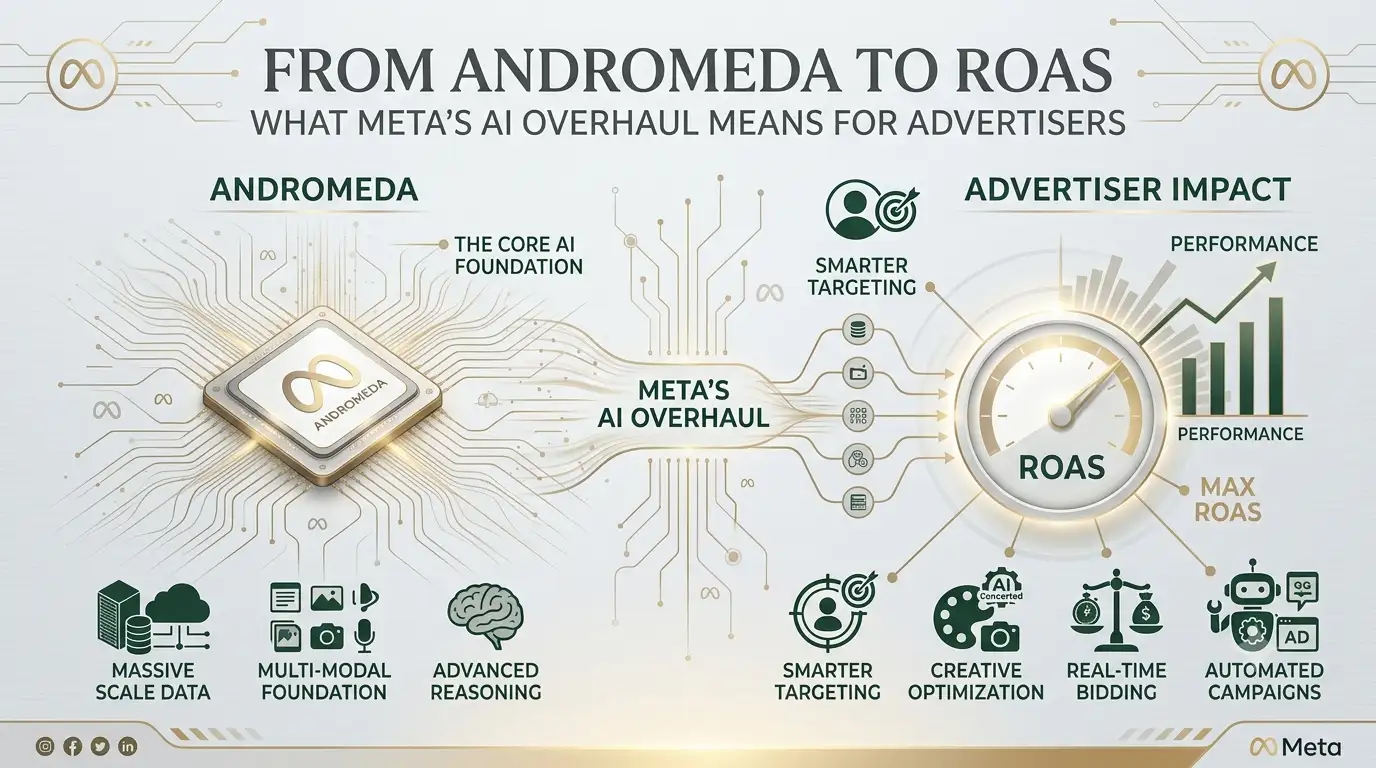
Here's the mechanism in plain terms. Before an ad ever competes in the auction that determines cost, it first has to survive a filtering step that decides whether it's even a contender for a given person. That filtering step used to run on fairly rigid rules. Now it runs on a deep learning model that's far better at matching the right creative to the right person in the right moment. The practical effect is that well-matched ads are winning more of the impressions that matter, and poorly-matched ads are getting filtered out earlier and more often than before.
That's good news if your creative happens to be well-suited to this new filtering. It's quietly bad news if it isn't — and the frustrating part is that a lot of advertisers who are losing efficiency right now have no idea the filtering step is even the cause. They're troubleshooting bids and audiences when the real issue is upstream.
Cost per result. Because retrieval is smarter about who sees what, Meta can afford to be more selective before impressions ever reach the paid auction. For advertisers whose creative and data quality are strong, this often shows up as more efficient delivery — the system isn't wasting your budget showing your ad to people unlikely to respond. For advertisers with thin, generic creative libraries, the opposite can happen: fewer of your impressions clear the retrieval bar, and the ones that do compete in a smaller, sometimes pricier field.
Conversion rate. A system that matches creative to context more precisely tends to lift conversion rates for advertisers who give it enough raw material to work with. This is one of the more measurable, trackable shifts — it's worth watching your conversion rate trend independent of spend, because a rising conversion rate with flat spend is a strong signal that retrieval is working in your favor.
Volatility. Perhaps the least discussed effect: day-to-day and week-to-week ROAS swings can look larger now, even without any change on your end. When a probabilistic model is making finer-grained, moment-by-moment matching decisions, small shifts in the broader competitive landscape or your own creative mix can ripple through performance more visibly than they did under a more rigid, rules-based system. Don't mistake normal noise for a real trend without giving it more time than you used to.
Creative volume is a budget-efficiency lever, not just a brand exercise. It's tempting to treat more creative variants as a "nice to have" for freshness. Under Andromeda-style retrieval, it's closer to a direct efficiency lever — a wider, more varied creative pool gives the system more legitimate options to match against real audience intent, instead of forcing thin material to work overtime across mismatched contexts.
Data cleanliness is now a cost line, whether you track it as one or not. Fragmented, delayed, or partial conversion signals don't cause a visible error. They just make every dollar you spend slightly less efficient, invisibly, for as long as the gap exists. Investing in solid server-side tracking (like Conversions API) and clean event structure has a real, if hard-to-isolate, ROAS payoff — arguably a better one per dollar than most creative or copy tweaks at this point.
Stop reflexively fragmenting campaigns. Splitting budget across many narrow, manually-targeted campaigns starves each one of the volume the retrieval and ranking systems need to learn efficiently. Consolidating into fewer, better-resourced campaigns — the philosophy behind Advantage+ — often produces a better blended ROAS than the same budget spread thin across granular manual structures, even though it feels like giving up control.
Judge tests over longer windows. With more probabilistic, real-time matching happening upstream, a single day or even a single week of ROAS data carries more noise than it used to. Extending your test windows and looking at trend lines rather than single data points will save you from chasing phantom wins and losses that are really just short-term variance.
Reallocate budget based on where retrieval is helping you, not just where CPA looks lowest today. Two campaigns can have similar surface-level costs while one is genuinely benefiting from smart retrieval matching and the other is barely clearing the bar. Digging into conversion rate trends and frequency data, not just headline CPA, will tell you which is which.
The single most common misstep right now is treating a ROAS dip as a signal to cut budget and tighten targeting — the instinct that used to work. Under the current system, that response can actively make things worse: less budget means less signal for the retrieval and ranking models to learn from, and tighter manual targeting means opting further out of the exact mechanism designed to find your best-fit audience automatically.
The better instinct, counterintuitively, is often to widen creative variety and loosen manual targeting constraints — giving the system more to work with rather than less — while making sure your underlying data is as clean as you can make it. That's a harder sell internally than "let's cut spend until it improves," but it's the response that actually aligns with how the system now operates.
Andromeda isn't a line item you'll ever see on an invoice, but it's already showing up in your ROAS whether you've noticed it or not. The advertisers pulling ahead right now aren't the ones with the cleverest bidding tactics — they're the ones who've quietly accepted that creative volume and data quality are now doing more of the heavy lifting than manual targeting ever did, and who've adjusted their budget and their patience accordingly.
If your ROAS has been drifting and you can't quite explain why, that's not necessarily a strategy problem. It might just be the first sign that the system underneath your campaigns has already moved on without waiting for you to catch up.

Have a project in mind? Let’s build something amazing together.
Webbitech — A Leading Web Design & Web Development Company with 15+ Years of SEO & Digital Marketing Expertise, Delivering Countless Success Stories
From idea to execution, we help businesses create high-performing websites and applications.
Start your journey today and take your brand to the next level.