Digital Marketing Company vs. Agency vs. Freelancer: Which One Actually Grows Your Business?
Posted Date : 05 Sep 2026
Digital Marketing Company vs. Agency vs. Freelancer: Which One Actually Grows Your Business?
You've decided to invest in digital marketing. Good move. But now comes the harder decision: who actually does the work?
Search "digital marketing company vs agency vs freelancer" and you'll find a dozen articles that describe each option and then shrug: "it depends on your needs." True, but not helpful when you're staring at three proposals with three wildly different price tags.
This guide breaks down what each option really delivers, what it costs, where it fails, and how to match your business stage to the right partner — so you stop guessing and start growing.
The Quick Answer
- Freelancers are best for single-channel, well-defined tasks and tight budgets.
- Digital marketing agencies are best for businesses that need a multi-channel strategy managed end-to-end.
- Digital marketing companies (larger, often full-service or enterprise-focused firms) are best for businesses that need scale, integrated tech stacks, and dedicated account teams.
Now let's get into why.
What Is a Freelancer?
A freelancer is an independent marketer who typically specializes in one or two skills — SEO, paid ads, content writing, or social media management. You hire them directly, often through platforms like Upwork, referrals, or LinkedIn.
Pros of Hiring a Freelancer
- Lower cost: No agency overhead means freelancers usually charge 30-50% less than agencies for comparable hourly work.
- Direct communication: You work with the person actually doing the task, not an account manager relaying updates.
- Flexibility: Easy to scale up or down, and contracts are usually short-term.
Cons of Hiring a Freelancer
- Limited bandwidth: One person can't realistically run SEO, PPC, email, and social simultaneously at a high standard.
- No backup: If they get sick, go on vacation, or move on, your campaigns stall.
- Inconsistent processes: Freelancers rarely have the reporting infrastructure, QA systems, or tools that agencies invest in.
Best for: Startups and solopreneurs with a narrow, well-defined need — like "optimize my Google Business Profile" or "write 10 blog posts a month."
What Is a Digital Marketing Agency?
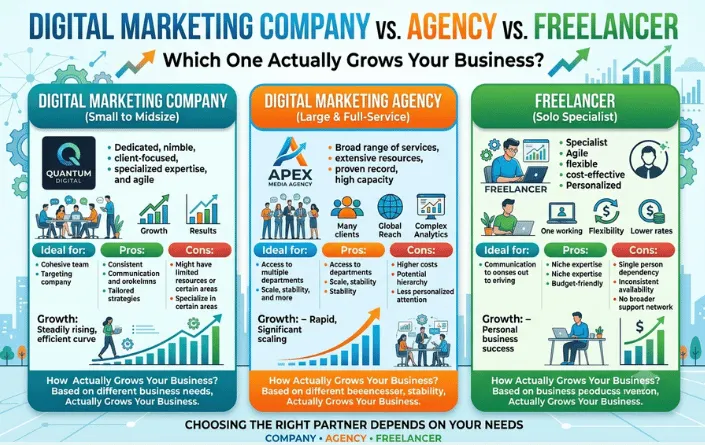
An agency is a team of specialists — strategists, SEO experts, ad buyers, designers, and copywriters — working together under one roof (or one remote structure) to manage your marketing as a coordinated system.
Pros of Hiring an Agency
- Cross-channel strategy: Your SEO, content, and paid ads work together instead of existing in silos.
- Built-in redundancy: If one team member is out, the account doesn't stop moving.
- Established processes: Agencies typically have reporting dashboards, QA checklists, and proven frameworks.
- Access to senior expertise: Good agencies bring strategists who've solved your exact problem for other clients.
Cons of Hiring an Agency
- Higher cost: Retainers commonly range from $1,500 to $10,000+ per month depending on scope.
- Account management layers: You may not talk directly to the person doing the work.
- Onboarding time: Agencies need weeks to understand your business before results show up.
Best for: Small to mid-sized businesses that need a full marketing engine — SEO, content, paid media, and analytics — without hiring an internal team.
What Is a Digital Marketing Company?
This is where terminology gets blurry, and it's worth clarifying because it changes your decision. A "digital marketing company" often refers to a larger, more established firm — sometimes with proprietary technology, industry specialization (e.g., healthcare, SaaS, e-commerce), or enterprise-grade service levels.
Pros of Hiring a Digital Marketing Company
- Scale and infrastructure: Dedicated departments for SEO, paid media, CRO, and analytics rather than generalist teams.
- Proprietary tools and data: Many larger companies build internal software for reporting, attribution, or automation.
- Proven track record: Established firms usually have case studies, testimonials, and industry certifications you can verify.
- Long-term partnership capacity: Built to support businesses through multiple growth stages, not just a single campaign.
Cons of Hiring a Digital Marketing Company
- Premium pricing: Larger firms often carry higher retainers to cover overhead and specialized staff.
- Less personal attention: You may be one of hundreds of accounts, especially with lower-tier retainers.
- Slower agility: Bigger organizations can mean more approval layers before campaign changes go live.
Best for: Established businesses or funded startups that need a long-term, integrated marketing partner and can commit to a meaningful budget.
Side-by-Side Comparison
| Factor |
Freelancer |
Agency |
Digital Marketing Company |
| Typical cost |
$$ |
$$$ |
$$$$ |
| Channel coverage |
1-2 channels |
Multi-channel |
Full-service, integrated |
| Speed to start |
Fast |
Moderate |
Slower (onboarding-heavy) |
| Consistency/redundancy |
Low |
Medium-High |
High |
| Reporting sophistication |
Basic |
Structured |
Advanced/proprietary |
| Best business stage |
Solo/startup |
SMB scaling up |
Established/enterprise |
How to Actually Decide: 4 Questions to Ask
- How many channels do I need managed? One channel → freelancer. Three or more → agency or company.
- What's my monthly budget, realistically? Under $1,000 → freelancer. $1,500–$8,000 → agency. $8,000+ → digital marketing company.
- How fast do I need to move? If you need something live this week, a freelancer or lean agency will outpace a large company's onboarding process.
- Do I need strategy or just execution? If you already have a marketing plan and need hands to execute it, a freelancer may suffice. If you need someone to build the strategy from scratch, go with an agency or company.
Red Flags to Watch For — Regardless of Who You Hire
- Vague reporting or "we'll show growth eventually" answers
- No clear point of contact or account owner
- Guarantees of a specific ranking position or follower count (this violates most platform policies and is a sign of black-hat tactics)
- Contracts with no exit clause or unclear deliverables
- Case studies with no verifiable client names or links
The Real Answer: Match the Partner to Your Growth Stage
There's no universally "best" option — there's a best option for where your business is right now.
- Just starting out? A specialized freelancer can get you moving without burning your runway.
- Ready to scale across channels? An agency gives you strategy plus execution in one relationship.
- Operating at scale with real budget? A digital marketing company brings the infrastructure and specialization to match.
The businesses that grow fastest aren't the ones that pick the "best" category — they're the ones that pick the right fit for their current stage, then re-evaluate as they grow.
FAQ
Is a digital marketing agency more expensive than a freelancer?
Generally yes. Agencies carry team overhead, so retainers are higher than a single freelancer's rate — but you're paying for coordinated, multi-channel expertise rather than one person's bandwidth.
Can a freelancer replace an entire marketing team?
For very small, single-channel needs, yes. Once you need SEO, paid ads, content, and analytics working together, one freelancer typically can't cover all of it at a professional standard.
What's the difference between a digital marketing agency and a digital marketing company?
The terms overlap, but "company" often implies a larger, more established organization with deeper resources, proprietary tools, and industry specialization, while "agency" can range from a two-person shop to a large firm.
How long before I see results from any of these options?
Most SEO and content efforts take 3-6 months to show measurable results. Paid advertising can show results within weeks, but sustained growth still depends on consistent strategy and optimization.
Should I hire in-house instead of any of these three?
In-house makes sense once your marketing spend and complexity justify a full-time salary and benefits — often once you're spending the equivalent of $8,000+ per month externally.