Posted Date : 05 Sep 2026
Choosing a digital marketing partner used to come down to a simple question: can they get you ranked on Google? That question hasn't gone away, but it's no longer the only one that matters.
Search behavior has changed. People increasingly get answers directly inside ChatGPT, Perplexity, Claude, and Google's AI Overviews, without ever clicking through to a website. That shift has created two new disciplines sitting alongside traditional SEO: Answer Engine Optimization (AEO), which focuses on getting your brand cited inside AI assistant responses, and Generative Engine Optimization (GEO), which extends that same goal to AI-generated summaries inside search engines. Marketers are also increasingly asked to plan around AI Optimization (AIO) and LLM Optimization (LLMO), depending on which agency you talk to.
Any agency you're evaluating in 2026 should be fluent in all of this — not treating AEO and GEO as an upsell bolted onto an old SEO retainer, but as part of one integrated visibility strategy. The agencies still selling "AI search" as a replacement for the fundamentals, rather than an extension of them, are usually selling a trend, not a strategy.
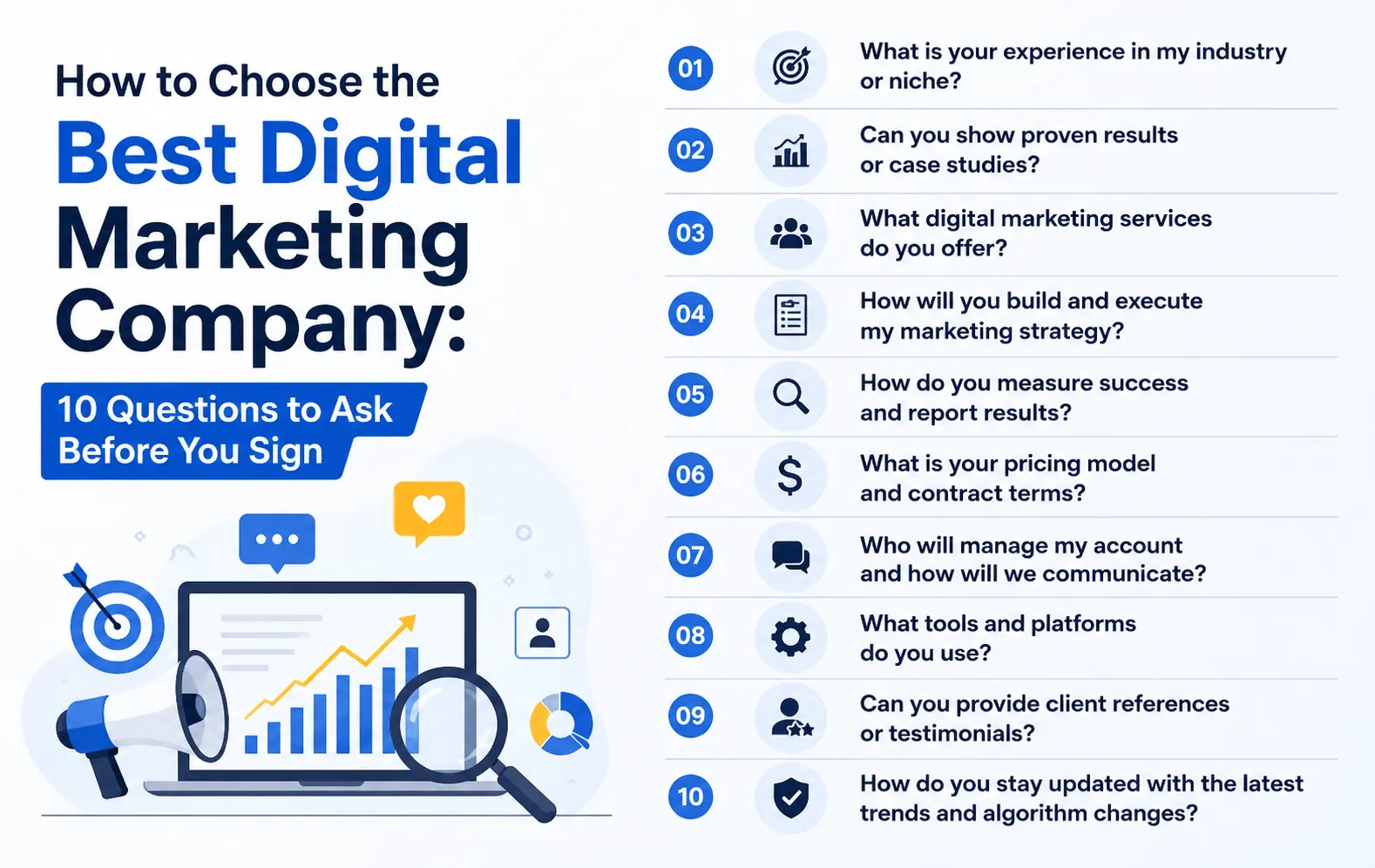
Before you sign a contract, you need a structured way to separate genuine expertise from a good sales pitch. Here are the 10 questions that do exactly that.
The foundations of SEO, AEO, and GEO overlap heavily: crawlable content, clear site structure, and factual claims a machine can safely repeat back to a user. What differs is emphasis. AEO and GEO reward specific, verifiable statements over persuasive marketing copy, and reward being cited even when that citation doesn't produce a click.
A strong answer here sounds like an integrated content and technical plan. A weak answer treats AEO as a separate, extra-cost service with its own disconnected tactics.
Ask to see a sample research document, not just a summary. You want evidence of:
Since Google retired FAQ rich results from traditional search snippets, structured question-and-answer content has become more important for a different reason: answer engines still parse it reliably, even without the old visual snippet. A capable agency should be able to explain how they:
Traditional rank tracking tells you where you sit in a results page. It says nothing about whether ChatGPT, Perplexity, or an AI Overview is actually citing your brand when someone asks a related question. Ask which tools or dashboards the agency uses to monitor:
If the agency can't describe a concrete measurement approach here, treat that as a gap — this is one of the fastest-moving areas in the industry and a genuine differentiator between agencies keeping pace and agencies coasting on old playbooks.
Ask for:
Be cautious of agencies that show only screenshots without context, or that can't explain why a campaign worked.
Digital marketing contracts often bury scope changes in vague language. Get clarity, in writing, on:
A polished sales team doesn't guarantee a skilled execution team. Ask:
Look for agencies offering:
Search and AI platforms update constantly. A capable agency should describe a process for monitoring changes across Google, Bing, and major AI assistants, and adjusting strategy quickly rather than reactively scrambling after traffic drops.
Before you sign, understand:
A trustworthy agency will answer this question directly, without hedging.
Once you've asked all 10 questions, compare answers side by side rather than agency by agency. The right partner should be transparent about pricing, honest about timelines (meaningful SEO and AEO results typically take three to six months, not weeks), and able to speak fluently about how AI is changing discovery — without treating it as a gimmick.
The goal isn't to find the agency with the flashiest pitch deck. It's to find the one whose process, team, and reporting match what your business actually needs to grow.
SEO optimizes content to rank in traditional search engine results pages. AEO focuses on getting your brand cited inside AI assistants like ChatGPT, Claude, and Perplexity. GEO applies that same goal to AI-generated summaries within search engines, such as Google's AI Overviews. They share the same technical foundations but differ in emphasis and measurement.
Costs vary widely by scope, industry, and market, typically ranging from a few hundred to several thousand dollars per month for small-to-midsize businesses. Focus less on the headline price and more on what's included, and whether the pricing model matches the results you need.
Most agencies need three to six months to show measurable movement in rankings, AI citations, or traffic, with meaningful ROI often taking six to twelve months depending on competition and starting point.
Agencies typically offer broader skill coverage (SEO, AEO, paid media, design, development) and more consistent capacity. Freelancers can be more cost-effective for narrow, well-defined projects but may lack backup coverage or the tooling larger agencies invest in.
No. AEO and GEO extend SEO rather than replace it — most people still find businesses through traditional search, so the fundamentals of crawlable, well-structured, credible content remain essential even as answer engines grow in importance.
Have a project in mind? Let’s build something amazing together.
Webbitech — A Leading Web Design & Web Development Company with 15+ Years of SEO & Digital Marketing Expertise, Delivering Countless Success Stories
From idea to execution, we help businesses create high-performing websites and applications.
Start your journey today and take your brand to the next level.