Posted Date : 28 Nov 2025
If you’re struggling to rank outside your immediate map radius, you’re not alone. One of the most common questions businesses ask is:
“How can I rank better beyond my location?”
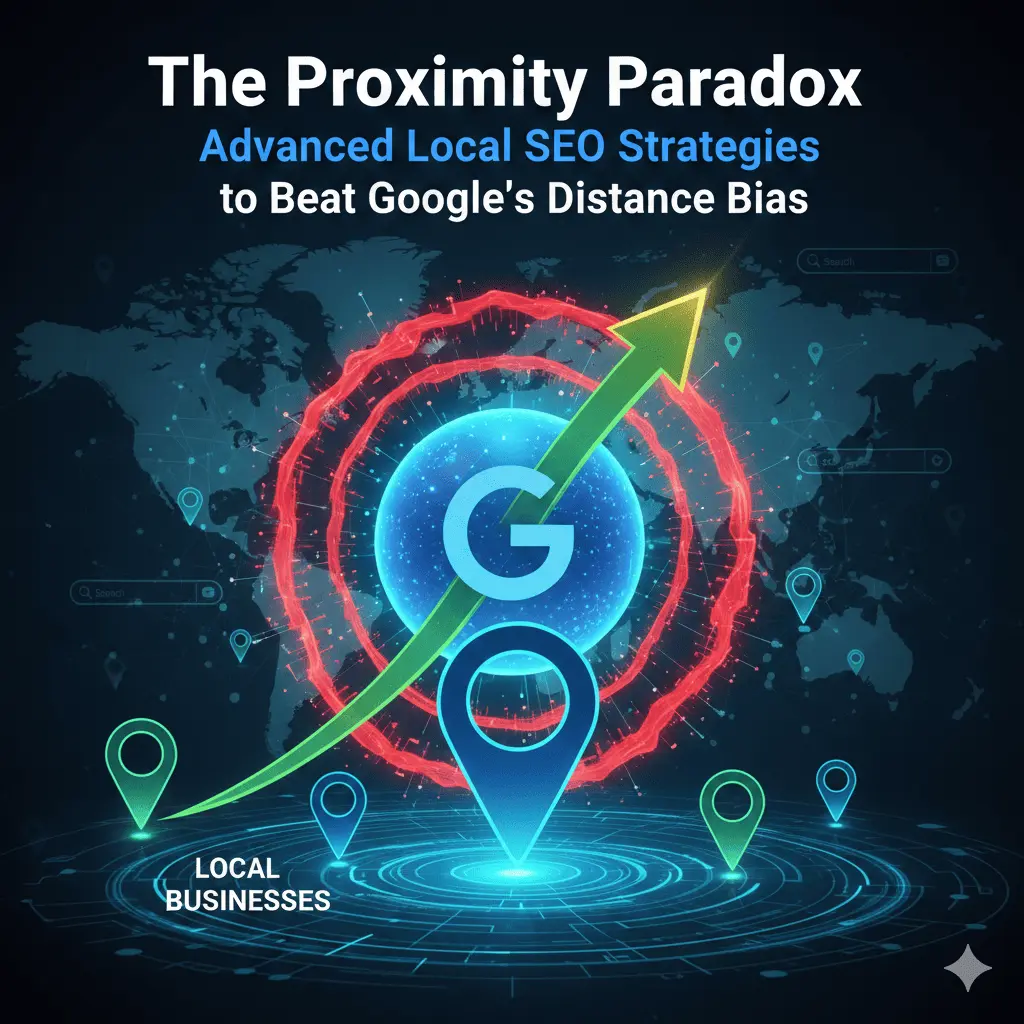
You might notice that your Google Business Profile (GBP) ranks strongly when you’re physically near your store. But move a few kilometres away, and those rankings begin to drop. This isn’t a glitch—it’s Google’s proximity bias in action.
Today, I’ll break down why proximity matters, how to beat distance bias, and advanced local SEO tactics—including entity building, review semantics, and strategic content localization—that actually work in 2026.
Google uses three core ranking signals for local search:
How closely your business matches the search intent.
Example: “tacos near me” → Restaurants serving tacos.
How well-known and trusted your business is, based on reviews, backlinks, mentions, and authority.
The distance between the user's current location and your physical location at the time of the search.
No matter how optimized your profile is, distance naturally suppresses visibility for local searches. The further away searchers are, the less likely Google is to show your business.
But here’s the good news…
👉 Proximity bias is NOT absolute. You can outrank competitors located closer to the searcher—if your entity signals and relevance are stronger.
Google uses a combination of:
GPS
Wi-Fi
Mobile network signals
IP addresses
Device activity & app behaviour
This gives them hyperlocal accuracy, allowing Google to return exact neighbourhood-level results.
Different keywords trigger different radius sizes.
Examples:
“Web design” → hyper local radius
“Web design company” → broad metro-wide radius
“Website development near me” → neighbourhood radius
“Website Design and Web Development Company In Coimbatore” → city-wide radius
This means some queries naturally allow you to rank further away than others.
Optimizing your profile is important—but it will never overcome proximity bias alone.
To expand your local ranking radius, you need:
Stronger prominence signals
More accurate entity information
Semantic review activity
Unstructured citations
Localized content clusters
Niche specialization
This is where real local SEO begins.
Below are proven methods that help businesses rank far beyond their physical radius.
1. Build a Stronger Entity: Become “Recognized” by Google:
Think of Google’s entity understanding like a knowledge profile of your business.
The stronger your entity:
The broader you rank
The more keywords you appear for
The more Google trusts your brand in a wider radius
Get mentioned on local news sites
Earn unstructured citations on blogs, magazines, and event pages
Participate in community events & sponsorships
Create highly specific topical pages on your website
Ensure your NAP is 100% consistent everywhere
Your goal: make your business discoverable, referenced, and contextually rich online.
2. Leverage Review Semantics (The Secret Weapon):
This is one of the most powerful (and underused) ways to expand ranking radius.
Google analyzes review language to understand:
Services you’re known for
Signature products
Neighbourhood relevance
Topic expertise
Example:
A Website Design Company in Coimbatore with 462 reviews mentioning “Webbitech” ranked for that search phrase across miles—even though it didn’t rank well for broader terms like “Website Design company.”
Ask customers to mention:
Specific services
Unique products
Neighbourhood references
Use-case experiences
Features or specialties
Provide prompts such as:
“If you loved our [product/service], feel free to mention it in your review—this helps more local customers find us!”
3. Earn Unstructured Citations (Not Just Directory Listings):
These are mentions of your business on:
Local blogs
Lifestyle magazines
Tourism sites
Event sponsorship pages
Podcasts
Local news articles
These citations create strong geographic & topical associations.
Search for opportunities using queries like:
“Best of [city]”
“Top restaurants in [area]”
“Local sponsors [city]”
“Things to do in [town]”
The more mentions you earn, the stronger your entity becomes.
4. Specialize to Expand Your Radius:
If your market is extremely competitive, ranking widely for generic terms like:
“grocery store”
“salon”
“dentist” …will be difficult.
But niche terms have lower competition and wider radius allowances.
Examples:
“Organic grocery store”
“Holistic dentist”
“Vegan bakery”
“Luxury spa therapy”
Find your unique specialty, dominate it, and watch your radius expand.
5. Localize Your Website Content Properly
Generic content won’t help. Hyperlocal content signals do.
Use the checklist:
Include city, neighbourhood, and landmark references.
Your online details must match store signage, GST details, and phone recordings.
Each page should have:
Complete address
Map embed
Local images
Local reviews
Local FAQs
Write about:
Local issues
Community updates
Area-specific services
Neighbourhood insights
This builds topical + geographic relevance.
6. Schema Helps Only If Kept Updated
Add Local Business schema, but don’t rely on it for ranking.
Its job: clarify, not “boost.”
7. When Needed, Use Ads to Fill the Gaps
In highly competitive cities, sometimes PPC or Local Service Ads complement organic radius expansion.
Organic + paid = maximum dominance.
Overcoming Proximity Bias Requires Smart Strategy:
You can overcome Google’s distance bias—just not with traditional “GBP optimization” alone.
Your path to ranking beyond your map radius depends on:
Being a stronger entity
Earning better review semantics
Getting mentioned across authoritative local sites
Creating highly localized content
Dominating a niche specialty
This is how you win:
👉 Prominence + Relevance > Distance
And when that happens, Google will trust you enough to show your business across a wider geographic radius.
Have a project in mind? Let’s build something amazing together.
Webbitech — A Leading Web Design & Web Development Company with 15+ Years of SEO & Digital Marketing Expertise, Delivering Countless Success Stories
From idea to execution, we help businesses create high-performing websites and applications.
Start your journey today and take your brand to the next level.