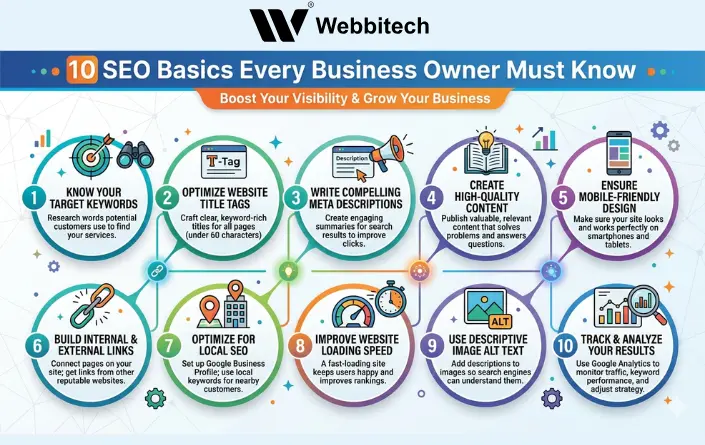
Whether you're running a small shop in Coimbatore or a growing startup across Tamil Nadu, understanding SEO basics can transform your business. Here are the 10 most important SEO fundamentals every business owner must know.
1. KeywordsRight words = right traffic2. On-Page SEOOptimize every page3. Technical SEOSpeed, crawl, structure4. BacklinksAuthority from others5. Local SEOGoogle Maps visibility6. ContentQuality over quantity7. User ExperienceKeep visitors engaged8. AnalyticsTrack what works9. Mobile SEOMobile-first indexing10. Social SignalsShares boost reach1. KeywordsRight words = right traffic2. On-Page SEOOptimize every page3. Technical SEOSpeed, crawl, structure4. BacklinksAuthority from others5. Local SEOGoogle Maps visibility6. ContentQuality over quantity7. User ExperienceKeep visitors engaged8. AnalyticsTrack what works9. Mobile SEOMobile-first indexing10. Social SignalsShares boost reach1. 🔑 Keyword Research — The Foundation of SEO
What it is: Keywords are the words and phrases your potential customers type into Google. If someone searches "best digital marketing agency in Coimbatore," those are keywords.
Why it matters: Without targeting the right keywords, even a beautifully designed website will get zero traffic.
How to do it:
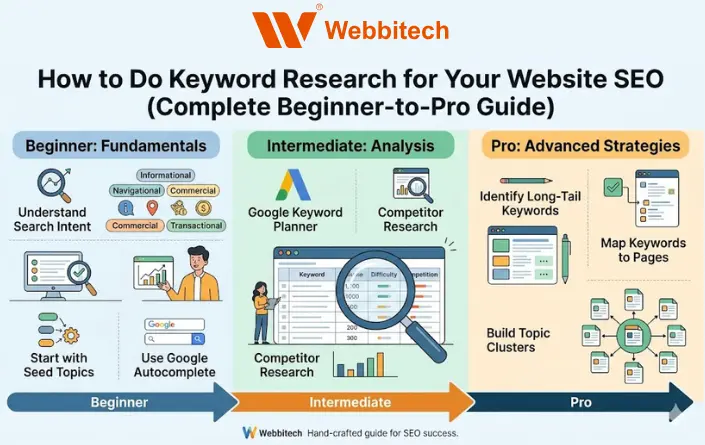
- Use free tools like Google Keyword Planner, Ubersuggest, or Google Search autocomplete
- Focus on long-tail keywords (3+ words) — they are less competitive and more targeted
- Mix high-volume keywords with local, niche-specific ones
- Understand search intent — is the user looking to buy, learn, or compare?
Pro Tip: A bakery in Coimbatore should target "fresh cakes Coimbatore" instead of just "cakes" — more specific = more conversions.
2. 📄 On-Page SEO — Optimizing Every Page
What it is: On-Page SEO refers to all the optimizations you make directly within your website pages to help search engines understand your content.
Key elements to optimize:
- Title Tag — The clickable headline shown on Google. Include your main keyword (under 60 characters)
- Meta Description — A 150–160 character summary that appears below your title in search results
- Headings (H1, H2, H3) — Structure your content clearly with keyword-rich headings
- URL Structure — Keep URLs short and descriptive (e.g.,
webbitech.com/seo-services) - Image Alt Text — Describe every image so Google can understand it
- Internal Links — Link to other relevant pages within your site
Pro Tip: Every page should target one primary keyword. Don't stuff multiple keywords into a single page — this confuses Google.
3. ⚙️ Technical SEO — The Engine Under the Hood
What it is: Technical SEO ensures that search engines can properly crawl, index, and understand your website. Even great content fails if your site has technical problems.
Core technical factors:
- Site Speed — Google penalizes slow websites. Aim for under 3 seconds load time
- XML Sitemap — A map that tells Google all the pages on your site
- Robots.txt — A file that tells search engines which pages to crawl or skip
- SSL Certificate (HTTPS) — Secure websites rank higher and build user trust
- Canonical Tags — Prevent duplicate content issues
- Structured Data (Schema Markup) — Help Google display rich results like star ratings, FAQs, and prices
Pro Tip: Use Google Search Console (free tool) to monitor your technical SEO health and fix crawl errors immediately.
4. 🔗 Backlinks — Building Your Website's Authority
What it is: A backlink is a link from another website pointing to yours. Google treats backlinks like votes of confidence — the more quality backlinks you have, the more trustworthy your site appears.
Why quality matters over quantity:
- A single link from a top news site is worth more than 100 links from random blogs
- Low-quality or spammy backlinks can actually hurt your rankings
How to earn quality backlinks:
- Write guest blog posts for industry websites
- Get listed in local business directories (Justdial, Sulekha, IndiaMART)
- Create shareable content — infographics, data studies, how-to guides
- Partner with local businesses for mutual mentions
- Get featured in local news or community sites
Pro Tip: Never buy backlinks. Google's algorithm detects unnatural link patterns and can penalize or deindex your site.
5. 📍 Local SEO — Getting Found in Your City
What it is: Local SEO helps your business appear in location-based searches like "web design company near me" or "restaurants in Coimbatore."
Why it's critical for small businesses: 46% of all Google searches are looking for local information. If you don't appear in local results, you're losing customers to your competitors every single day.
Key Local SEO actions:
- Claim and optimize your Google Business Profile (formerly Google My Business) — Add photos, hours, services, and respond to reviews
- NAP Consistency — Your Name, Address, and Phone number must be identical across all platforms
- Get Customer Reviews — Businesses with more positive reviews rank higher in Google Maps
- Local Citations — Get listed in directories like JustDial, Sulekha, Yellow Pages India
- Location Pages — If you serve multiple cities, create a dedicated page for each
Pro Tip: Ask every happy customer to leave a Google Review. Reviews are one of the strongest local ranking signals.
6. ✍️ Content Marketing — King of SEO
What it is: Content is the fuel that powers SEO. Blog posts, videos, FAQs, case studies, and guides attract visitors, earn backlinks, and establish your authority in your industry.
The golden rule of content: Create content that genuinely helps your audience — not just content stuffed with keywords.
Types of content that rank:
- How-to guides and tutorials
- Listicles (like this article!)
- FAQ pages targeting question-based searches
- Case studies showing real results
- Local content targeting your city or region
- Video content (YouTube videos rank on Google too)
Content Strategy tips:
- Publish consistently — at least 2–4 blog posts per month
- Aim for 1,000+ words for articles targeting competitive keywords
- Update old content regularly to keep it fresh
- Use images, infographics, and videos to increase engagement
Pro Tip: Answer questions your customers actually ask. The best blog ideas come from your own customer service conversations.
7. 🖥️ User Experience (UX) — Keep Visitors Happy
What it is: Google tracks how users behave on your website. If visitors land on your page and immediately leave (high bounce rate), Google interprets this as a signal that your page isn't useful — and drops your ranking.
Core UX signals Google measures:
- Bounce Rate — How quickly do users leave your site?
- Time on Page — How long do they stay and read?
- Pages per Session — Do they explore more of your site?
- Core Web Vitals — Google's official metrics: Largest Contentful Paint (LCP), First Input Delay (FID), Cumulative Layout Shift (CLS)
How to improve UX:
- Make your website easy to navigate with a clear menu
- Use readable fonts (minimum 16px) and proper spacing
- Add clear Call-To-Action (CTA) buttons — "Call Now," "Get a Quote," "Book a Free Consultation"
- Avoid intrusive popups that frustrate users
- Ensure fast loading — compress images, minimize code
Pro Tip: Test your website on different devices (mobile, tablet, desktop) and ask 3 people to find a specific piece of information. If they struggle, your UX needs work.
8. 📊 Analytics — Measure Everything
What it is: SEO without data is guesswork. Analytics tools show you exactly where your traffic comes from, which pages rank, what keywords drive visits, and where people drop off your site.
Essential tools (all free):
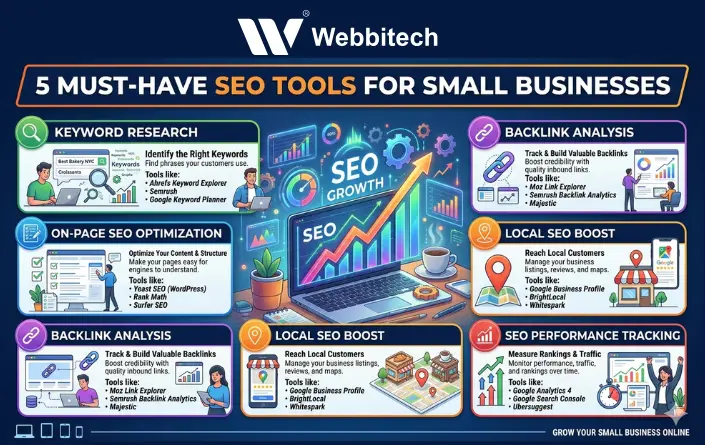
- Google Analytics 4 (GA4) — Tracks all website traffic, user behavior, and conversions
- Google Search Console — Shows which keywords bring visitors, crawl errors, and indexing status
- Google PageSpeed Insights — Measures your site speed and Core Web Vitals
- Ubersuggest / Ahrefs (free version) — Keyword tracking and competitor research
Key metrics to track monthly:
- Organic traffic (visits from Google)
- Keyword rankings (which position you appear on Google)
- Click-Through Rate (CTR) from search results
- Conversion rate (how many visitors take action)
- Top performing pages
- Bounce rate by page
Pro Tip: Set up a simple monthly SEO report. Even 30 minutes of analysis per month can reveal powerful insights that guide your entire strategy.
9. 📱 Mobile SEO — Non-Negotiable in 2026
What it is: Google uses Mobile-First Indexing, meaning it primarily uses the mobile version of your site to determine rankings — even for desktop searches.
Shocking reality: Over 70% of internet users in India browse on mobile devices. If your website is not mobile-friendly, you're not just losing rankings — you're losing customers.
How to ensure mobile-friendliness:
- Use a Responsive Design — your site automatically adjusts to any screen size
- Test with Google's Mobile-Friendly Test tool (free)
- Make buttons and links large enough to tap with a finger
- Avoid Flash or pop-ups that block mobile content
- Ensure fast mobile loading — mobile users abandon sites that take over 3 seconds
Pro Tip: Try browsing your own website on your smartphone right now. If anything feels frustrating or cramped, it needs to be fixed immediately.
10. 📣 Social Signals — Amplify Your SEO
What it is: While social media links don't directly boost your Google rankings, they amplify your content's reach — which leads to more backlinks, brand searches, and traffic. All of these indirectly strengthen your SEO.
How social media supports SEO:
- More shares = more people discovering and linking to your content
- Strong brand presence = more branded searches on Google (a positive ranking signal)
- Social profiles rank on Google — your Facebook and Instagram pages appear in brand searches
- Social media drives traffic, which improves engagement metrics
Best platforms for Indian businesses:
- Facebook & Instagram — Ideal for local businesses, promotions, and visual content
- YouTube — The second largest search engine in the world
- LinkedIn — Powerful for B2B businesses
- Google Business Profile — Not social media, but posts here directly impact local SEO



 Get Free Consulting
