Posted Date : 28 Aug 2026
A startup building its first app is solving a different problem than a bank rolling out a new feature to ten million existing users. The bank already knows its audience, has a working product, and needs precision. A startup doesn't yet know if anyone wants what it's building. That single difference changes everything about how the app should be scoped, built, and priced — and it's the reason hiring a generalist enterprise-focused agency for an early-stage product so often goes badly.
Enterprise builds optimize for stability, compliance, and integration with existing systems. Startup builds optimize for speed and learning. An enterprise team might spend three weeks writing requirements documents before touching a design tool. A startup usually can't afford that—every week spent in requirements gathering is a week not spent finding out whether the idea works at all.
"Minimum viable product" gets thrown around loosely, and it's worth being precise. An MVP is not a half-finished app. It's the smallest version of the product that lets you test your core assumption with real users. If your app's whole premise is "people will pay to book a service faster than calling," your MVP needs booking and payment — and can skip loyalty programs, referral systems, and a polished onboarding animation. Those come later, if the core assumption holds.
Every founder wants a fast build and a feature-complete one. You rarely get both. The discipline is deciding, deliberately, which features are load-bearing for your test and which are nice-to-haves masquerading as requirements. A startup app development company worth hiring will push back on scope, not just build whatever's asked.
Native development — building separately for iOS and Android — gives the best performance and the deepest access to device features. It also roughly doubles your development cost and timeline, since you're building two apps instead of one. For a first product still validating demand, that math rarely makes sense.
Flutter and similar cross-platform frameworks let one codebase run on both platforms, cutting cost and time meaningfully. It's the right default for most early-stage apps. The exception is when your product leans heavily on platform-specific hardware or bleeding-edge OS features—augmented reality, deep camera manipulation, or background processing quirks specific to one platform. In those narrower cases, natives still win.
The instinct to add "just one more feature" is constant, and it's usually driven by fear rather than user need — fear that the app looks incomplete, fear that a competitor has that feature, fear of launching something small. Resist it. A tightly scoped MVP that ships in eight weeks and gets real feedback beats a sprawling one that ships in six months and answers a question nobody asked anymore by the time it's live.
A genuinely minimal MVP — one core flow, basic authentication, a simple backend — can realistically ship in six to eight weeks. Add payments, a more complex data model, or admin tooling, and ten to fourteen weeks is more honest. Anyone quoting two weeks for a real, tested product is either building something trivial or skipping testing entirely, and you'll find out which after launch.
For context: a lean MVP with two or three core features generally runs ₹3–8 lakh in the Bangalore market. That range moves with design complexity and backend requirements, but it's a reasonable planning figure for a first conversation with a development partner — not a final number, since that only comes after proper scoping.
The most expensive mistake is picking based on the lowest quote without asking what's excluded from it. The second is skipping a discovery phase entirely and jumping straight to "just build this," which usually produces an app that technically matches the brief and still misses the point. The third is treating the developer relationship as a one-time transaction instead of a partnership that continues past launch.
Watch for agencies that agree to everything without pushing back, quote a fixed price before understanding your product, or can't show you a real, currently-live app they've built. Also worth noting: if a sales conversation never mentions testing or post-launch support, that's usually because neither is budgeted in.
Ask who specifically will work on your build, not just who's in the pitch deck. Ask what happens when scope changes mid-project, because it will. Ask what ownership terms apply to your code and design files. And ask what support costs after launch — a number should exist before you sign, not after your first bug report.
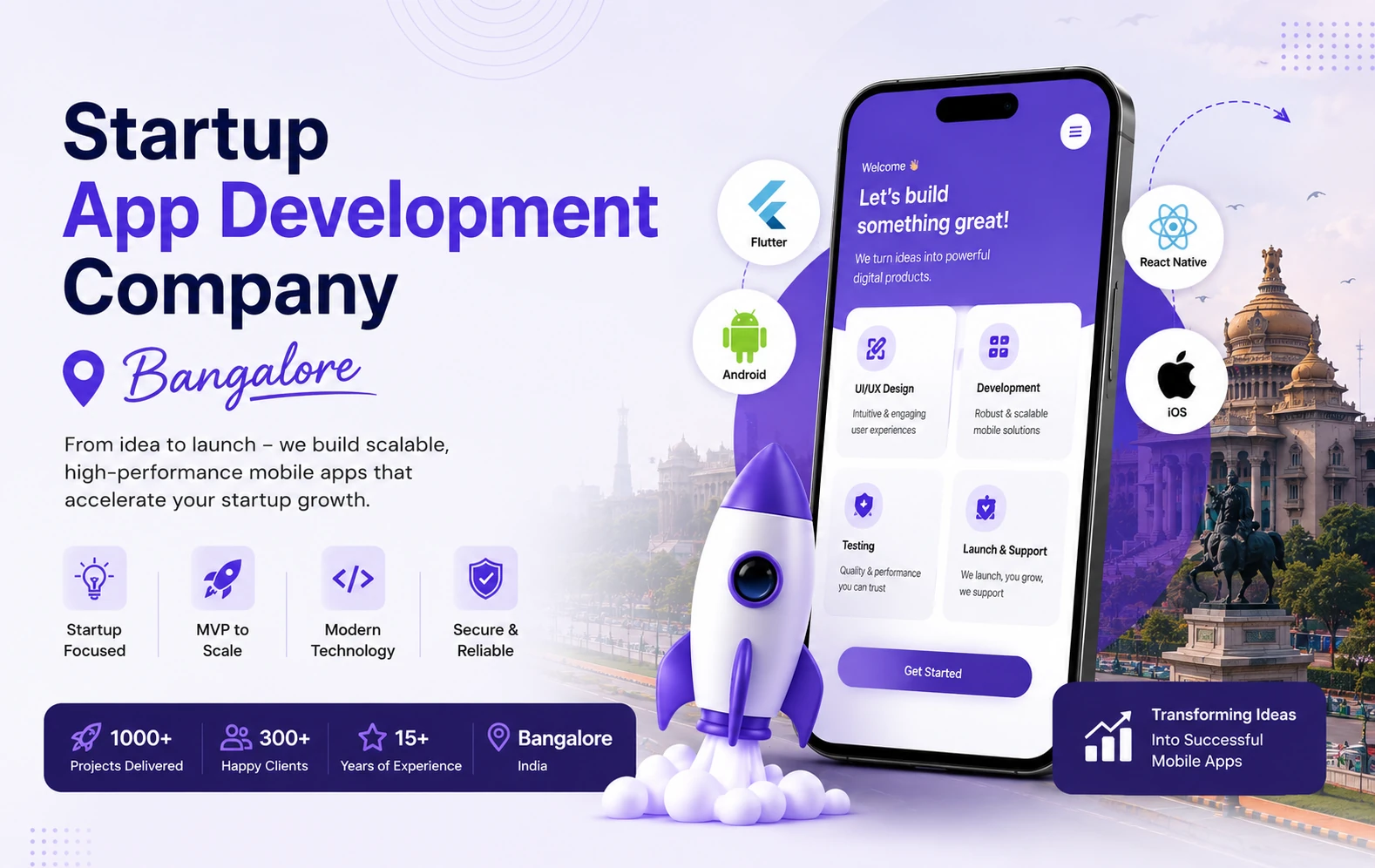
Webbitech starts every startup engagement with a short discovery conversation focused on one question: what does this app need to prove? From there, scope gets built around that answer, not around a generic feature checklist. Builds run in short sprints so founders see working software every couple of weeks, not a single reveal three months in — which matters most for startups, since the ability to redirect early is often more valuable than the original plan.
Launch is the beginning of the useful part, not the end of the project. Real users behave differently than anyone predicted in planning meetings. The best use of the first few weeks post-launch is watching actual usage data and support tickets, then deciding what to build next based on evidence instead of assumption. A development partner who disappears after launch leaves you without the team that understands why the app was built the way it was.
If your MVP can be scoped down to a genuinely minimal test — one flow, basic functionality — bootstrapping it is often faster than raising money first, since a working product (even a rough one) makes fundraising conversations considerably easier. Raising first tends to make sense when the product genuinely can't be tested without infrastructure that costs real money upfront: heavy backend processing, hardware, or regulatory requirements that can't be shortcut.
A startup app doesn't need every feature you can imagine. It needs the smallest version that tells you the truth about whether your idea works. Everything about how you choose a development partner—the tech stack, the timeline, the scope conversation—should serve that one goal first.

Have a project in mind? Let’s build something amazing together.
Webbitech — A Leading Web Design & Web Development Company with 15+ Years of SEO & Digital Marketing Expertise, Delivering Countless Success Stories
From idea to execution, we help businesses create high-performing websites and applications.
Start your journey today and take your brand to the next level.