For Business Enquiry: +91 97892 39293
WEBBITECH

Reels vs. Static Images: Which Ad Format Actually Converts Better in 2026?

Reels vs. Static Images: Which Ad Format Actually Converts Better in 2026?

Reels vs. Static Images: Which Ad Format Actually Converts Better in 2026?

If you've managed a Meta or Instagram ad account any time in the last year, you've probably asked yourself this question while staring at Ads Manager: do I put my budget into Reels, or do I stick with the static image ads that have worked for years?

The honest answer is "it depends"—but that's a cop-out unless you can see the actual numbers. So this post walks through the 2026 performance data step by step, so you can make the call for your own account instead of guessing.

Step 1: Look at the raw conversion numbers

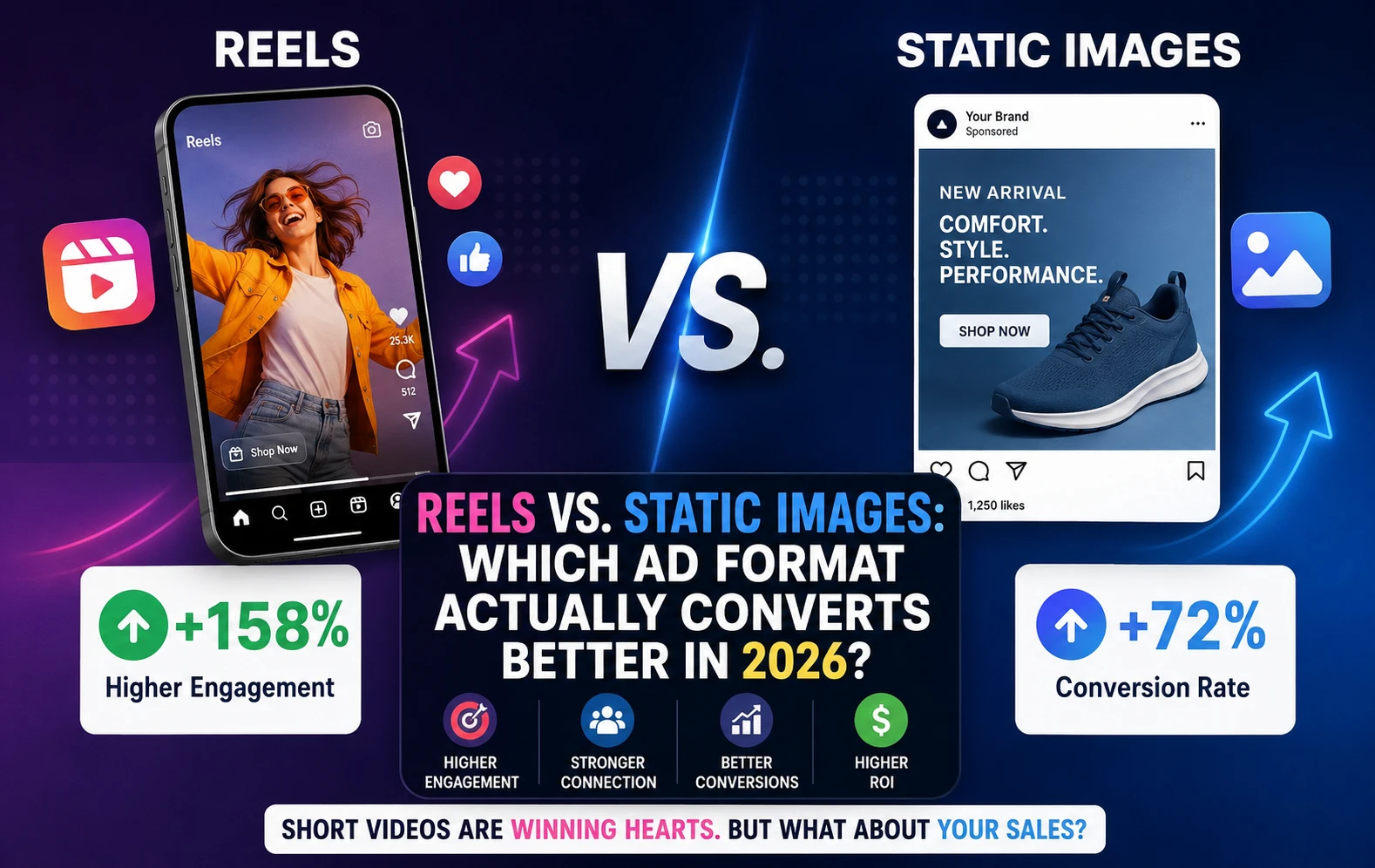
Start with the headline data. According to Meta's Q1 2026 performance benchmarks, which analyzed over 4.1 million active Instagram ad campaigns, <cite index="7-1">Reels-based direct-response ads achieved an average conversion rate of 3.8%, while static image ads remained at 1.3%</cite>. Brands that shifted the majority of their budget toward video reels saw meaningfully higher overall returns as a result.

That's a huge gap. But conversion rate isn't the whole story—you also need to know what it costs to get there.

Step 2: Compare cost-efficiency (CPM, CPC, CPA)

This is where the picture gets more nuanced:

  • Reels are cheaper per click. Reels ads deliver roughly 26% lower cost-per-click than standard Feed placements.
  • Vertical video with sound has a much lower CPA. <cite index="2-1">Vertical 9:16 video ads with sound have a 34.5% lower cost-per-acquisition than image ads and a 15% lower CPA than silent video ads on Reels. </cite>
  • But static images still win on raw CPM. Static image ads cut CPM by roughly 38% in cold prospecting audiences compared to video, since they're cheaper to serve and don't need to hold attention for several seconds to register a view.

So the pattern: video (and Reels specifically) tends to win on click and conversion efficiency, while static images win on cost per impression, especially early in a campaign or with small test budgets.

Step 3: Understand why Reels convert better

A few structural reasons show up consistently across 2026 data:

  1. Attention capture. Viewers spend meaningfully longer looking at a video creative than a static image before scrolling past, giving the ad more time to make its case.
  2. Algorithmic reach. Reels now make up a large share of all Instagram ad placements and get pushed to a large potential audience, including a majority of viewers who don't already follow the advertiser — a strong discovery engine that static posts don't get the same boost from.
  3. Click-through rate. Reels generate a substantially higher click-through rate to brand websites than static ads.
  4. Engagement signals feed distribution. Reels also see much higher share and save rates than static posts, and Meta's algorithm treats those signals as a sign of content quality, further increasing distribution.

Step 4: Know where static images still win

Reels don't win everywhere, and treating static creative as obsolete is a common (and costly) mistake. Static images and carousels tend to outperform in the following:

  • Direct-response campaigns with tight CPA targets — static images communicate a value proposition faster than a video that needs several seconds to make its point.
  • Cold prospecting and rapid A/B testing — you can produce and test many image variations in the time it takes to make one video, and CPMs are lower.
  • Bottom-of-funnel, high-intent moments — many shoppers scroll grids and saved posts right before purchasing, and an information-dense static product shot or carousel is often the asset that closes the sale, even when a Reel introduced the brand earlier.
  • Trust-heavy sectors—categories like finance, healthcare, and professional services—often convert better with clear, credible static content than with fast-moving video.
  • Carousels specifically for education and savings—multi-slide carousels that walk through a process or comparison get saved at roughly 1.8x the rate of a single image.

Step 5: Segment performance by funnel stage, not by format alone

The strongest advertisers in 2026 aren't picking one format—they're matching format to funnel stage:

Funnel Stage Best Format Why
Top of funnel (awareness/reach) Reels / short video Lower CPMs at scale, strong non-follower reach, high watch time
Middle of funnel (consideration) Mix of Reels + carousel Carousels build trust and educate; Reels sustain engagement
Bottom of funnel (conversion) Static image / carousel Faster value-prop communication, lower CPA for direct response, referenced right before purchase
Retargeting Static images or longer video (30–60s) The audience is already warm; can move faster to the offer

Step 6: Set a realistic default budget split—then adjust

Given all of the above, a sensible starting point for most B2C accounts in 2026 is a roughly 60–80% Reels / 20–30% static and carousel split, adjusted for your specific vertical, creator, and campaign goal. Several 2026 industry analyses converge on similar numbers, generally recommending 60–80% of content or spend toward Reels for reach-driven objectives, with static and carousel content held back deliberately for detail shots, announcements, and conversion-focused moments.

Don't treat this ratio as gospel, though—it hides a lot of variance:

  • Some creators are strong photographers whose static content punches above the average.
  • Some products (SaaS, anything that needs demonstration) benefit disproportionately from video.
  • Trust-heavy or high-ticket categories (real estate, financial services) may need more static/carousel weight than the default split suggests.

Step 7: Measure the right metrics for each format

A common mistake is judging Reels the same way you judge static image ads. Reels behave differently, so measure them differently:

  • Track Cost Per View (CPV) and hook rate (the percentage of viewers who watch past the first few seconds) for Reels, not just CPM. 9:16 vertical audio-on-video optimized for CPV can achieve a substantially lower CPA than the same creative optimized purely for impressions.
  • Track CTR and CPA directly for static image ads — they tend to communicate value fast enough that basic funnel metrics tell you what you need to know.
  • For both, watch creative fatigue. Static image ads tend to fatigue faster (performance often drops by around day 7 at a frequency of 3+) than video ads (which tend to hold up a few days longer), so refresh static creative more often.

Step 8: Run the actual test before you commit a budget.

All of the averages above are directional, not guarantees—a boring Reel will still flop, and a great static image can outperform mediocre video. Before locking in a long-term split:

  1. Run a head-to-head test: the same offer, one version as a static image and one as a short Reel (9–15 seconds tends to perform best for prospecting).
  2. Let each ad reach Meta's learning phase exit (roughly 50 conversions) before comparing results—video ads tend to exit the learning phase faster than image ads in 2026 data.
  3. Compare CTR, CPA, and conversion rate side by side, not just engagement.
  4. Let the winner guide your budget split going forward, and retest quarterly since benchmarks shift.

If your goal is reach, awareness, or top-of-funnel growth, Reels are the clear 2026 winner—better click-through rates, better cost efficiency at scale, and a much stronger discovery engine. If your goal is fast, low-cost direct-response conversion, especially on a tight budget or in a trust-heavy category, static images and carousels still hold their own and, in some cases, outperform video.

The advertisers getting the best results in 2026 aren't choosing one format over the other — they're using Reels to fill the funnel and static or carousel content to close it, then measuring both independently instead of judging one format by the other's metrics.


Note: Ad performance benchmarks vary by industry, audience, and creative quality. Use the figures above as a starting point for testing, not as a guarantee for your specific account.

About the Author

Webbitech is a leading website design and web development company in Coimbatore,

🚀 Get Your Project Started

Have a project in mind? Let’s build something amazing together.

🏆#1 Website Design & Web Development Company - Trusted by 500+ Business Owners

Webbitech — A Leading Web Design & Web Development Company with 15+ Years of SEO & Digital Marketing Expertise, Delivering Countless Success Stories

🚀Let’s Build Something Amazing Together

From idea to execution, we help businesses create high-performing websites and applications.
Start your journey today and take your brand to the next level.
Related Articles

The Real Differentiator in Advertising Now

The Real Differentiator in Advertising Now

From Andromeda to ROAS: What Meta's AI Overhaul Means for Advertisers

From Andromeda to ROAS: What Meta's AI Overhaul Means for Advertisers

Inside Meta Andromeda: The AI Infrastructure Powering Meta Ads in 2026

Inside Meta Andromeda: The AI Infrastructure Powering Meta Ads in 2026

Meta's Andromeda AI: How It Works and What It Means for Your Ad Strategy

Meta's Andromeda AI: How It Works and What It Means for Your Ad Strategy

Performance Max Isn't "Set and Forget" Anymore—And That's a Good Thing

Performance Max Isn't "Set and Forget" Anymore—And That's a Good Thing

WhatsApp Webbitech Get Free Consulting Get In Touch