Posted Date : 16 Jul 2026
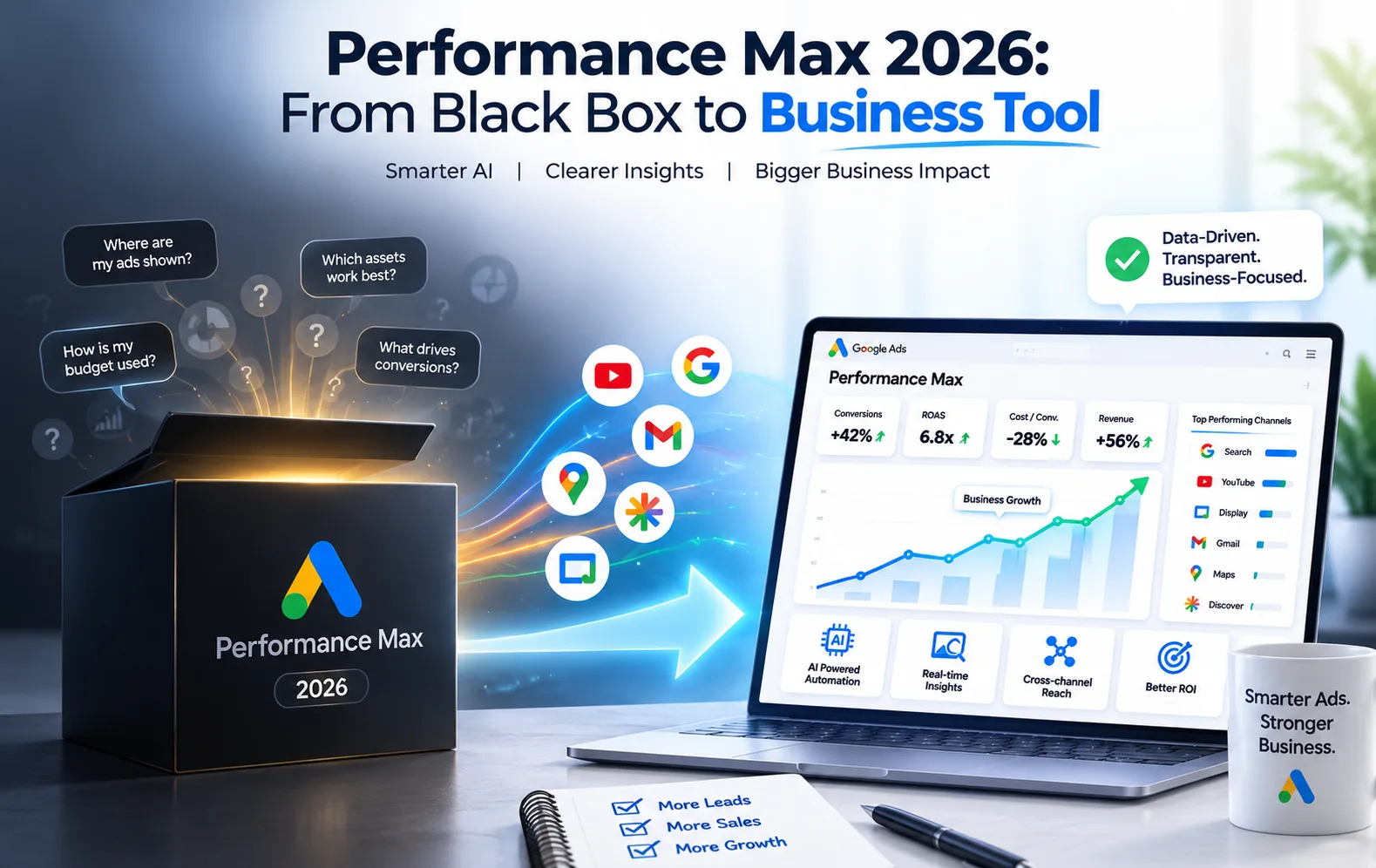
For years, Performance Max earned a reputation as Google Ads' most powerful — and most opaque — campaign type. Advertisers handed over budget, creative assets, and conversion goals, then watched Google's AI decide where the money went across Search, Shopping, Display, YouTube, Discover, Gmail, and Maps. The results were often strong. The visibility into why was almost nonexistent.
That's no longer the whole story. Over the past year, Google has shipped a steady stream of updates aimed squarely at PMax's biggest criticism: the lack of control. In 2026, Performance Max looks less like a black box you feed budget into and more like a business tool you can actually steer, audit, and optimize with intent.
Here's what's changed and how to put it to work.
The single biggest complaint about early PMax was simple: advertisers had no reliable way to stop the algorithm from spending on irrelevant search queries. That gap has closed. Campaign-level negative keywords are now available directly in the interface, giving advertisers a fast way to cut off junk traffic the moment they spot it, instead of routing requests through account reps and waiting days for a fix.
Pair that with new search terms reporting, and you get something PMax never really offered before: a feedback loop. You can see what triggered an ad, decide whether it fits your business, and act on it in minutes rather than escalating a support ticket.
What to do with it: Build a negative keyword list before you launch, not after. Recovering wasted spend is always harder than preventing it.
"Where is my ad actually showing?" used to be one of the hardest questions to answer in PMax. Google's channel performance report changes that. Media buyers can now see network-segmented data on where impressions and clicks are coming from, including previously murky territory like Google Search Partners placements.
This matters for two reasons. First, brand suitability: you can finally confirm your ads aren't showing up somewhere that damages the brand. Second, budget logic: the new channel report lets you see whether a channel's volume is consistent relative to spend over time, so you can judge whether YouTube is quietly driving assisted conversions or Display is just adding clutter.
What to do with it: Review channel-level performance weekly during any transition period, and use it to inform asset investment — not just budget cuts.
PMax has always used audience signals to guide the AI, but advertisers had almost no way to act on that data themselves. That's shifting. New first-party audience exclusion controls let you remove specific customer lists from a campaign — useful if you want budget going toward new customer acquisition rather than re-engaging people who already converted.
Full audience reporting now breaks down performance by age range and gender, and device-level control has become more direct. None of this turns PMax into a fully manual campaign type, but it does mean you're no longer flying blind on who the algorithm is reaching.
What to do with it: Don't overcorrect. Launch broad, watch the new demographic and device breakdowns, and only exclude segments once you have evidence they're a poor fit for your offer.
A new in-platform budget report lets advertisers project end-of-month spend and see how changes to daily budget actually affect pacing. This closes a long-standing gap where budget adjustments felt like a guessing game, especially for accounts managing seasonal spend or tight monthly caps.
What to do with it: Use the forecast before making reactive budget changes late in the month—it's designed to answer exactly the "what happens if I raise this?" question advertisers used to have to test blindly.
Google has expanded the video asset limit per asset group from five to fifteen, cutting down on the fragmentation advertisers previously dealt with when trying to run multiple aspect ratios or formats. More significantly, a new beta lets advertisers A/B test different asset sets within a single PMax campaign while holding common assets constant—something conversion rate optimization teams have been asking for since PMax launched.
Beyond asset testing, Google also rolled out formal PMax experiments, letting you test Performance Max against Shopping, Search, or Display campaigns directly or measure the incremental "uplift" PMax provides when layered alongside your existing campaign mix.
What to do with it: Treat creativity like a variable you control, not a black-box input. Run structured asset experiments rather than swapping creative assets reactively based on gut feel.
For e-commerce advertisers, a new shopping overlap report shows which products are being served across multiple campaigns, letting you exclude underperformers from specific campaigns the same way you'd apply negative keywords to search queries. It's a small feature with outsized impact for catalogs where PMax and Shopping campaigns have historically competed against each other invisibly.
None of these updates turn Performance Max into a fully manual campaign type—and that's not really the point. The AI still handles bid optimization and cross-channel budget allocation. What's changed is that advertisers no longer have to accept that automation as unaccountable. You can see where the budget goes, exclude what doesn't work, test what does, and forecast what's coming.
If you're still running PMax the way it launched—trusting the algorithm and checking in occasionally—2026 is the year to change that habit. A few practical starting points:
Performance Max was never short on results. What it lacked was trust — the kind that comes from being able to see how a system works, not just what it produces. In 2026, Google has finally started closing that gap, and the advertisers who take advantage of it will be running a materially more accountable version of PMax than the one that launched just a few years ago.
Have questions about implementing these updates in your account, or want a walkthrough of how to prioritize them for your specific goals? Let's talk.

Have a project in mind? Let’s build something amazing together.
Webbitech — A Leading Web Design & Web Development Company with 15+ Years of SEO & Digital Marketing Expertise, Delivering Countless Success Stories
From idea to execution, we help businesses create high-performing websites and applications.
Start your journey today and take your brand to the next level.