Posted Date : 01 Sep 2026
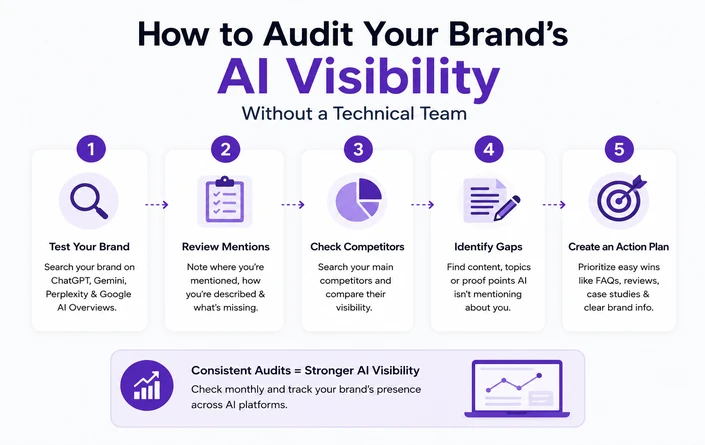
If you want to know whether ChatGPT, Perplexity, or Google's AI Overviews mention your brand, you don't need a developer or a monitoring platform to find out. You need a spreadsheet, 15–20 questions your buyers would actually ask, and about an hour. Run those questions across two or three AI engines, record what comes back, and you have a working baseline—the same starting point most paid AI-visibility tools are built on top of.
An AI visibility audit is a check of whether — and how — your brand shows up when someone asks an AI assistant a question related to your category. It's different from a traditional SEO audit, which looks at keyword rankings and backlinks. Here, you're checking three things: whether you're mentioned at all, how accurately you're described, and which competitors or third-party sources show up instead of you.
This matters because a growing share of buyers now skip the search results page entirely. They ask ChatGPT or Perplexity a question, read the synthesized answer, and build a shortlist—sometimes without ever clicking a traditional link. If your brand isn't in that answer, you weren't just unranked. You were never in the conversation.
Different AI engines pull from different sources and weight them differently, so checking only ChatGPT gives you a partial — sometimes misleading — picture. Perplexity leans heavily on live web citations and rewards data-backed, well-sourced pages. Gemini is tied into Google's ecosystem, so traditional search signals still carry weight there. ChatGPT blends training data with browsing and tends to favor clear, conversational answers. Claude tends to favor primary, technical sources over marketing copy.
The practical implication: test at least two engines, ideally three (ChatGPT, Perplexity, and Gemini or Google AI Overviews), because a brand that's well-represented in one can be invisible in another.
You don't need a paid tool for a first-pass audit—a browser and a spreadsheet get you a real baseline. Here's the process.
Write questions the way a real buyer would type them, not keyword strings. Spread them across these categories so you see the full picture:
| Prompt type | Example | What it tells you |
|---|---|---|
| Branded | "What is [Your Company]?" | Whether the AI knows who you are and describes you accurately |
| Category | "Best [your category] for [use case] " | Whether you appear at all when no one names you |
| Problem-solution | "How do I solve [problem your product solves]?" | Whether you're recommended as a solution, not just a name |
| Comparison | "[Your Company] vs [Competitor]" | How you're positioned against competitors head-to-head |
Test each prompt in ChatGPT, Perplexity, and Gemini or Google AI Overviews. Run each one at least twice — answers aren't always identical between sessions, and a single response can be a fluke rather than a pattern.
For each prompt, log:
A simple spreadsheet with these four columns, one row per prompt per engine, is enough. This becomes your baseline — you'll compare future audits against it.
One missing mention isn't a crisis. A pattern across ten prompts where competitors consistently appear and you don't—or where you appear but are described inaccurately—tells you where to focus first.
An audit that ends at "here's our score" isn't finished. Once you have your baseline, prioritize fixes in this order:
Once you're past a one-off check, dedicated tools can automate the tracking. Semrush's AI Visibility Toolkit and Ahrefs' Brand Radar are the two most established options, though neither is free—Semrush's add-on starts at roughly $99/month, and Ahrefs' Brand Radar is priced separately per AI platform tracked, which can run considerably higher. Smaller, standalone AI-visibility trackers have also emerged at lower price points. None of this is necessary to get your first real baseline — the manual method above is what these tools are largely automating.
How often should I re-run this audit?
Monthly if you're actively working on improving visibility or you're in a fast-moving category; quarterly is reasonable as a maintenance check otherwise.
What if my brand shows up but is described wrong?
That's usually a signal your public information is inconsistent—different descriptions or categories across your website, Google Business Profile, LinkedIn, and review sites. Standardizing those is typically the fastest fix.
Do I need to test every AI engine that exists?
No. Start with ChatGPT, Perplexity, and one Google surface (AI Overviews or AI Mode). Add Claude if your buyers are technical, or Gemini specifically if they're deep in Google's ecosystem.
Can a small team really do this without hiring anyone?
Yes — the manual process above is deliberately built to run with a browser and a spreadsheet in about an hour. The paid tools mentioned are for scaling this up later, not a prerequisite for starting.
Don't wait for a tool budget to find out where you stand. Block an hour this week, write your 15–20 prompts, and run the manual audit above. The baseline you get today is the only way to know if anything you do about AI visibility next is actually working.
Have a project in mind? Let’s build something amazing together.
Webbitech — A Leading Web Design & Web Development Company with 15+ Years of SEO & Digital Marketing Expertise, Delivering Countless Success Stories
From idea to execution, we help businesses create high-performing websites and applications.
Start your journey today and take your brand to the next level.