Posted Date : 31 Aug 2026
Every new advertising platform gets measured against the incumbents, and ChatGPT Ads is no exception. But holding it up next to Google and Meta reveals something more interesting than a simple feature comparison — it reveals three fundamentally different theories about how people discover and decide on purchases. Understanding those differences matters now, before ChatGPT Ads becomes another line item marketers scramble to master after the fact.
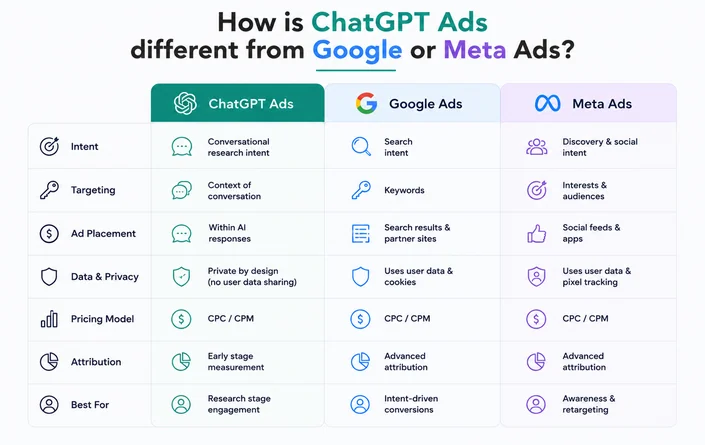
Google Ads runs on explicit intent. A user types "best running shoes for flat feet," and that phrase is a direct, unambiguous signal of what they want. Meta Ads runs on inferred intent—built from likes, follows, scroll behavior, and demographic data—predicting what someone might want before they've said so. ChatGPT Ads introduces a third model entirely: conversational intent. Ads are matched based on the live context of a dialogue—what's being discussed right now, combined with chat history and prior ad interactions—rather than a static query or a behavioral profile.

Google's targeting foundation is the keyword—advertisers bid on specific search terms and match types. Meta's foundation is the audience—interest categories, lookalikes, and custom audiences built from pixel data. ChatGPT Ads discards both models. There's no keyword list to build and no audience segment to define in the traditional sense. Instead, relevance emerges from the shape of the conversation itself, which means creative strategy has to account for fluid, exploratory dialogue rather than fixed search phrases or static interest tags.
On Google, ads sit above or alongside organic search results — visually distinct but embedded in the same results page. On Meta, ads are woven into the native feed experience, designed to blend with organic content. ChatGPT Ads take a more restrained approach: sponsored content appears as a clearly labeled, subtly tinted box beneath an AI-generated response, explicitly separated from the answer itself. OpenAI has been firm that ads never alter or influence what ChatGPT actually says — a boundary neither Google nor Meta enforces in quite the same structural way, since sponsored and organic content on those platforms often compete for the same visual real estate.
Meta's targeting has historically relied on extensive first- and third-party behavioral data, and Google similarly draws on search history, location, and cross-device signals. ChatGPT Ads takes a notably different privacy stance: ad matching happens entirely within OpenAI's own infrastructure, and personal user data is not shared with advertisers. Advertisers receive relevance-matched placement without direct access to the underlying behavioral signals — a meaningfully different data-sharing arrangement than what Meta's Ads Manager or Google's Customer Match tools provide.
All three platforms run auction-based pricing, but the mechanics diverge. Google's auction weighs bid amount against quality score. Meta's auction factors in bid, estimated action rate, and ad quality. ChatGPT Ads uses a relevance-weighted, second-price auction, where creative quality can let a lower bid outrank a higher one that's less contextually relevant. Reported entry costs in live markets start around $3–5 per click, with CPMs in the $25–60 range—figures that sit in a comparable ballpark to premium placements on the more established platforms, though direct benchmarking is still early given how new the channel is.
Google typically captures users at the point of active search — often mid-to-lower funnel, close to a purchase decision. Meta excels at top-of-funnel discovery and mid-funnel retargeting, catching users who weren't actively searching but are receptive to a well-placed suggestion. ChatGPT Ads appears to occupy an earlier, more exploratory research phase — the moment someone is actively working through a decision in conversation, asking follow-up questions, comparing options out loud. Early advertisers like Best Buy have framed this as reaching customers "in those moments" of research that increasingly happen inside a chat window rather than a search bar.
Google and Meta both offer mature, deeply built-out attribution ecosystems—conversion APIs, multi-touch attribution windows, and extensive reporting dashboards refined over more than a decade. ChatGPT Ads, still in its first year of commercial existence, has a comparatively thinner measurement stack. Marketers testing this channel should expect fewer attribution options and less historical benchmarking data than they're used to on the incumbent platforms, at least in the near term.
None of this makes ChatGPT It's a replacement for Google or Meta—it's a genuinely different tool suited to a genuinely different moment in the customer journey. Brands that treat it as a like-for-like swap will likely misapply their existing creative and targeting playbooks. Those that treat it as a complementary, research-stage channel — with its own creative logic built around conversation rather than keywords or feeds — stand a better chance of getting real value once wider access opens up.
No. It targets a different stage of the customer journey — early, conversational research — rather than replacing search intent capture (Google) or social discovery and retargeting (Meta).
Does ChatGPT Ads use keywords like Google Ads?
No. There's no keyword bidding. Relevance is determined by the context of the live conversation, chat history, and prior ad interactions instead of matched search terms.
Not in the traditional sense. There are no interest categories, lookalikes, or custom audience uploads to build in the way Meta's Ads Manager works. Targeting instead emerges from conversational context.
The matching process differs meaningfully — it happens entirely within OpenAI's infrastructure, and advertisers don't receive direct access to personal user data the way some Meta and Google tools allow through pixel and Customer Match data.
Reported entry costs ($3–5 per click, $25–60 CPMs) sit in a comparable range to premium placements on the established platforms, though benchmarking is still early given how new the channel is.
There isn't enough mature, cross-market data yet to say definitively. Early figures suggest a similar cost range to premium Meta and Google placements, but this will likely shift as the auction matures and more advertisers enter.
If you already run Google and Meta, treat ChatGPT Ads as a complementary test budget rather than a reallocation—its strength lies in an earlier research-stage touchpoint your existing channels may not fully capture.
Not yet at the same depth. Google and Meta have over a decade of refined attribution infrastructure; ChatGPT Ads' measurement stack is still early and comparatively limited.

Have a project in mind? Let’s build something amazing together.
Webbitech — A Leading Web Design & Web Development Company with 15+ Years of SEO & Digital Marketing Expertise, Delivering Countless Success Stories
From idea to execution, we help businesses create high-performing websites and applications.
Start your journey today and take your brand to the next level.