Google Ads vs Meta Ads in 2026: Which One Is Right for Your Business?
Posted Date : 13 Jul 2026
"Should I put my budget into Google or Meta?" is one of the most common questions a business owner asks when starting paid advertising — and it's usually the wrong question. The two platforms solve different problems: one captures demand that already exists; the other creates demand that didn't know it existed yet. Here's how to work through the decision step by step, using current 2026 cost and performance data.
Step 1: Understand the core difference in how each platform works
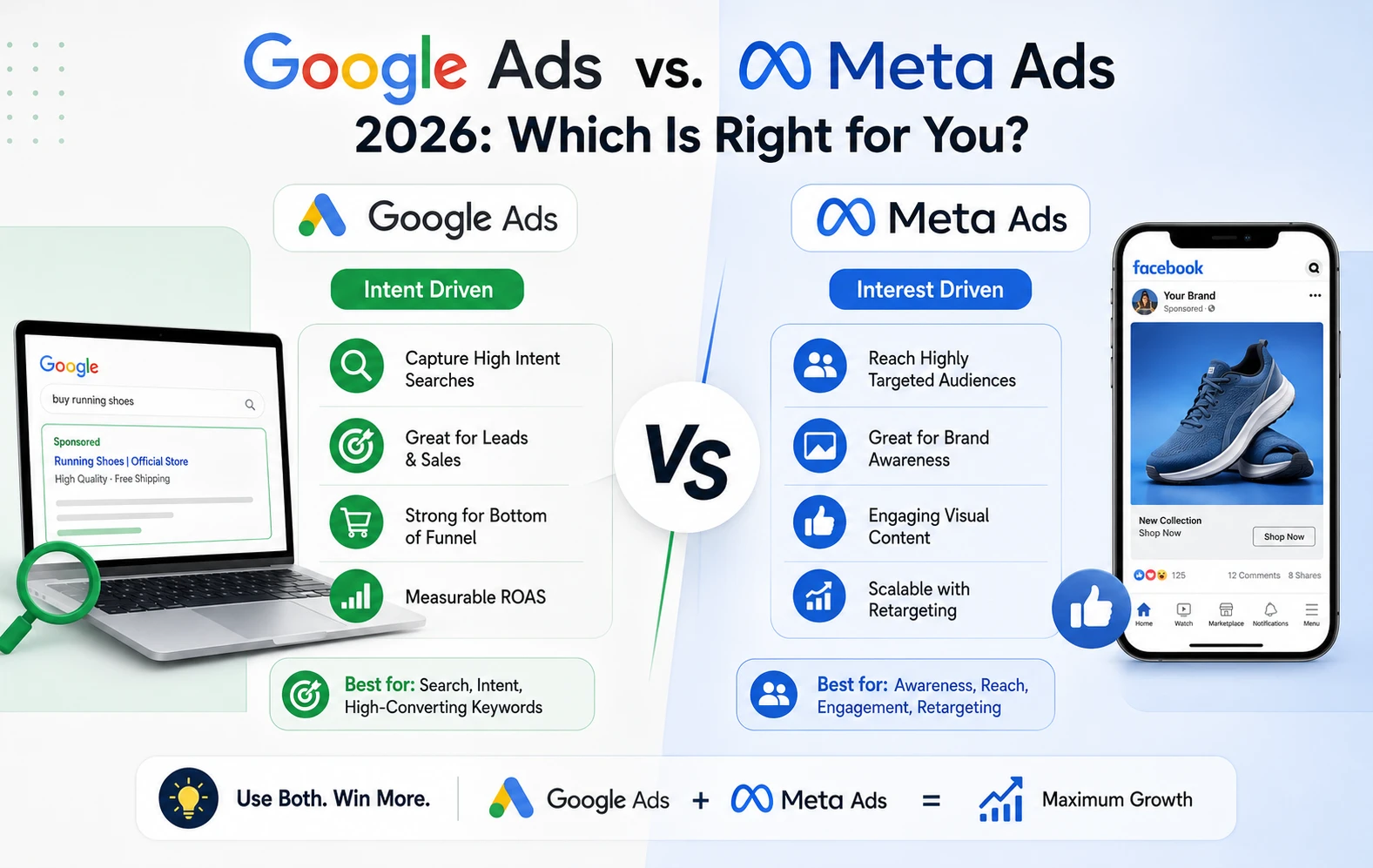
Google Ads (primarily Search) captures intent. Someone types "emergency plumber near me" or "best CRM for small "teams"—they already know what they want, and your ad meets them at the moment of active searching.
Meta Ads (Facebook and Instagram) create demand. Ads are shown based on who someone is — their interests, behavior, and demographic profile — not what they're actively searching for. You're interrupting a scroll to introduce a product or offer the person wasn't necessarily looking for.
This single distinction explains almost every other difference between the platforms: cost, conversion rate, creative requirements, and which businesses tend to win on each.
Step 2: Compare the raw cost numbers
Cost benchmarks vary across sources, but the direction is consistent: Meta is cheaper per click; Google converts at a higher rate per click. Rough 2026 US averages:
| Metric |
Google Ads |
Meta Ads |
| Average CPC |
~$4–5+ (varies heavily by industry) |
~$0.50–2.50 |
| Average CPM |
Higher, driven by keyword competition |
~$8–14 broad, $12–22 interest-based, $18–35 retargeting |
| Average conversion rate |
~4–8% (search, service industries); one industry report cites 3.75% blended |
~1–3% cold traffic, 5–12% warm retargeting; one report cites 0.9% blended |
Read this table carefully—cheaper clicks don't automatically mean better ROI. A $1 Meta click converting at 1% and a $5 Google click converting at 6% can land at a very similar cost per acquisition once you do the math. Direct cost comparison between the platforms is genuinely misleading unless you compare them on cost-per-outcome, not cost-per-click or cost-per-impression alone.
Step 3: Match the platform to your business type
This is the single most useful filter for most businesses:
- Local service businesses — dentists, HVAC companies, plumbers, lawyers, and similar categories — typically see faster, more predictable results with Google Ads, because customers are already actively searching for exactly what they offer at the moment of need.
- E-commerce, restaurants, med spas, and other visually driven, browse-and-discover businesses tend to perform better on Meta, where strong creative can introduce a product to someone who wasn't looking for it yet but is receptive to the offer.
- B2B companies often get better lead quality from Google, since buyers there are actively searching for a solution category rather than being interrupted mid-scroll.
- High-stakes, high-cost categories—legal, insurance, and financial services—tend to be considerably more expensive on Google specifically because competition for those keywords is intense; this is worth factoring into your budget expectations before you commit.
Step 4: Weigh creative requirements against your team's strengths
The two platforms ask for very different production skills:
- Google Search is primarily text-based. Headlines, descriptions, and ad copy carry most of the weight. If your team is strong at copywriting but light on design or video production, Search is the more accessible starting point.
- Meta is visual-first. Image, video, and carousel quality carries most of the conversion weight — a weak, generic-looking ad on Meta will underperform regardless of targeting. If your team can produce strong photography, video, or motion content, Meta offers more room to differentiate from competitors.
- Google's Performance Max and Display campaigns do require visual assets too, but the core Search product — often the highest-intent, highest-converting placement — remains largely copy-driven.
Step 5: Consider your budget size before splitting spending.
If your total monthly ad budget is small—roughly under $3,000/month—the practical advice from 2026 practitioners is consistent: pick one platform and focus, rather than splitting a small budget across both. Both platforms' algorithms need enough conversion data flowing through a campaign to optimize effectively, and dividing a limited budget usually means neither platform's algorithm gets enough signal to perform well. Grow one channel to a stable, profitable state first, then expand into the second.
Step 6: Understand how the platforms complement each other at scale
Once the budget allows for both, most 2026 practitioner consensus has shifted away from "either/or" and toward a complementary allocation. A few patterns show up consistently:
- Meta generates interest; Google captures intent. Cold prospecting on Meta introduces your brand to new people. Some of those people don't convert immediately — they search for your brand name on Google later. If you're running Meta at scale but not bidding on your own brand keywords on Search, you're leaking some of that captured demand to competitors bidding on your brand name.
- Retargeting works on both platforms but plays different roles. Meta retargeting to warm audiences (site visitors, video viewers, and engaged followers) often delivers the strongest ROAS on the platform, since CPMs are higher but so is the conversion rate. Google's Remarketing Lists for Search Ads and Display retargeting serve a similar warm-audience role in a different format.
- Running both together tends to lift overall results. Brands running Meta and Google simultaneously report meaningfully higher overall conversion rates than single-platform advertisers, largely because the two channels reinforce each other across the funnel rather than competing for the same conversion.
Step 7: Run the numbers on your specific offer
Generic benchmarks only get you so far — the right platform often comes down to your product's price point and margin. As a rough illustration: a lower-priced product with a modest conversion rate on cheap Meta clicks can land at a similar cost-per-acquisition as the same product converting at a higher rate on more expensive Google clicks. Before committing meaningful budget to either platform:
- Estimate your realistic conversion rate on each platform for your specific offer (not the industry average).
- Multiply by your expected CPC to get a rough cost-per-acquisition for each.
- Compare that CPA against your margin and average order value to see which platform actually pencils out for your business — not just which one has cheaper clicks.
Step 8: Set up tracking before you spend meaningfully on either
Whichever platform you choose, weak conversion tracking is one of the most common reasons campaigns underperform on both. Before scaling spend:
- Confirm conversion tracking is properly configured — Google Ads conversion tracking and Meta's Conversions API, not just pixel-based browser tracking, which has become less reliable due to privacy restrictions.
- Make sure you're measuring cost-per-qualified-outcome (a real lead or sale), not just cost-per-click or cost-per-lead, especially on Meta where lead volume can look strong while lead quality is weak.
- Give each platform's algorithm real time and enough conversion volume to exit its learning phase before judging performance or making major budget changes.
Step 9: Make the decision and revisit it
Put it together into a simple decision framework:
- Choose Google first if customers actively search for what you offer, you're in a local service category, your team is stronger at copy than visual production, or you're B2B and lead quality matters more than lead volume.
- Choose Meta first if your product is visual, impulse-friendly, or benefits from discovery rather than active search; your team can produce strong creative; or you're in e-commerce, hospitality, or a visually-driven consumer category.
- Run both once your budget comfortably supports meaningful spend on each (each platform's algorithm needs enough data to optimize), and treat Meta and Google as complementary funnel stages rather than competing channels.
- Revisit the split periodically. Both platforms update targeting, automation (Advantage+ on Meta, Performance Max on Google), and bidding tools regularly, and your own conversion data over time is a better guide than any generic benchmark.
There's no universal winner between Google Ads and Meta Ads in 2026 — only a better fit for your specific business, offer, and team's strengths. Google tends to win when customers already know what they want and are actively searching for it; Meta tends to win when a strong visual and message can create interest that didn't exist a moment before. Most growing businesses eventually use both, with Meta building awareness and demand at the top of the funnel and Google capturing the intent that follows.
Note: Cost and conversion benchmarks vary significantly by industry, region, and campaign quality. Use the figures above as a starting point for planning, and validate against your own account data once campaigns are live.

About the Author
Webbitech is a leading website design and web development company in Coimbatore,